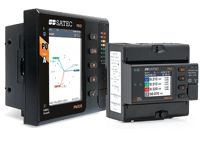

Revenue-grade power metering and Class A power quality analysis, from the branch circuit to the utility interconnect. SATEC has designed and built its own meters, firmware, and software since 1987. Dynamic represents the line across Northern California and Northern Nevada with local engineering support.

Measurement is usually the last thing specified and the first thing blamed. When a tenant bill is disputed, a utility interconnection is reviewed, or a machine trips and the customer says the power was fine, the argument is settled by whoever has data. The facility with data wins. The facility without data pays for the retrofit, and retrofitting measurement into a live panel costs far more than designing it in.
Three things worth knowing before you pick a meter, none of which show up on a datasheet comparison:
1. Accuracy class is a system property, not a meter spec. A Class 0.2S meter reading through an ordinary 1 percent external CT is a 1 percent system. The meter spec on the datasheet is not the number your billing or your interconnection agreement sees. SATEC's HACS current sensors act as the primary CT with a milliamp output direct to the meter, one CT in the chain instead of two, which is how the accuracy class on the box survives all the way to the report.
2. Class A has editions. "Class A power quality" refers to IEC 61000-4-30, and that standard has revisions. If a spec or an SLA calls for Class A, it is worth asking which edition. SATEC's PRO Series and PM17x PRO analyzers carry Class A Edition 3.1, the current revision. We will tell you plainly which SATEC families carry which edition, including where an older family carries the prior one.
3. Revenue-grade is a paperwork status, not a marketing word. At a CAISO interconnection point, the revenue meter is not an open choice. It comes off CAISO's authorized revenue meter list, a short list of approved vendors, and SATEC is on it (the EM920). Approval is configuration-specific, so we confirm the exact configuration against the requirement at quote time rather than waving the word "compliant" around. That is true of most revenue and compliance metering: the certificate matters more than the brochure.

You cannot cut energy costs, bill accurately, or settle a power quality dispute with equipment you cannot trust. SATEC has designed and manufactured its own hardware, firmware, and software in-house since 1987, which is why the line covers AC and DC measurement on one platform instead of a patchwork of third-party boxes. On our line card, SATEC is the "prove it"
layer: power gets converted and switched, machines get controlled, and SATEC is how you know what actually happened.
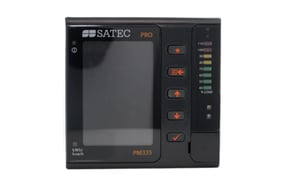
Panel-mount and DIN-rail multifunction meters, from the Class 0.5S workhorse tier (13x Series) to the Class 0.2S PRO Series that bundles metering, power quality, and control logic in one instrument.
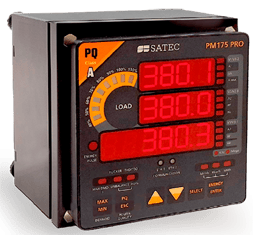
Class A analyzers for EN 50160, IEEE 519, and IEEE 1159 reporting, waveform capture, and fault recording. PM17x PRO installs in the same footprint as the thousands of PM17x units already in the field.
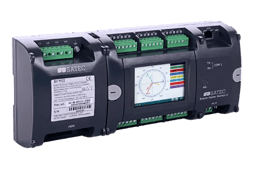
BFM-II monitors up to 54 single-phase or 18 three-phase circuits from one device. Panel-board sub-metering for plants, MCCs, and data center electrical rooms without a wall of meters.
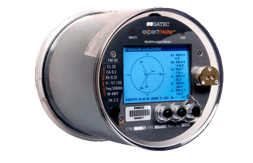
EM720 and EM920 for utility interconnection and substation metering. EM920 is on the CAISO authorized revenue meter list.
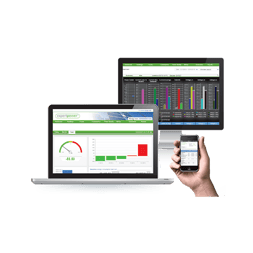
PAS analysis software ships with every instrument at no charge. ExpertPower adds cloud energy management across sites.

Machine builders and OEMs. PQ measurement built into the tool means that when a disturbance dispute comes in, you can show whether the problem was your machine or their power. The measurement pays for itself the first time it is not your fault.
Data centers. Branch-circuit monitoring at the panel board, Class A power quality at the facility level, revenue metering at the service entrance. One vendor, one software layer, from rack circuit to interconnect.
Substations and interconnection. IEC 61850 Ed. 2, DNP3, and the protocol set modern digital substations actually use, plus CAISO-listed revenue metering at the points that need it.
BESS, EV charging, and DC systems. Revenue-grade DC metering is rare. SATEC does it on the same platform as AC, which matters when your interconnection agreement starts asking for numbers on the DC side.
What accuracy class the application actually requires, and what the CT chain does to it.
Which PQ standard you have to report against (EN 50160, IEEE 519, IEEE 1159).
Circuit counts and whether one BFM-II replaces a panel full of meters.
Comms: Modbus, BACnet, DNP3, IEC 61850, and what your SCADA or BMS expects.
Whether the compliance paperwork (CAISO, revenue certification) matches the configuration.
Review products, find catalogs, request datasheets, and see certifications: