

Dynamic Measurement and Control Solutions
    • Applications
      • Industrial Automation & Production Equipment
      • Semiconductor & Test Equipment
      • Robotics, Robot Cells & Mobile Robots
      • Food, Beverage & Process Equipment
      • Life Sciences, Medical & Laboratory Equipment
      • Commercial, Self-Service & Public-Use Equipment
      • Transportation, Mobility & Vehicle Systems
      • Heavy Equipment, Mobile Machinery & Outdoor Systems
      • Energy, Power & Electrification Systems
      • Data Centers & Digital Infrastructure
      • Building, Facility & Site Systems
    • Products
    • Design Path
      • The Design Path
      • Design Once, Build Many
      • Power That Performs
      • Machine Intelligence & Control
      • Industrial Data Pathways
      • Wired to Last
    • The Detail
    Dynamic Measurement and Control Solutions
    Opens mobile navigation.

    Click to call. 4087809190

    • Applications
      • Industrial Automation & Production Equipment
      • Semiconductor & Test Equipment
      • Robotics, Robot Cells & Mobile Robots
      • Food, Beverage & Process Equipment
      • Life Sciences, Medical & Laboratory Equipment
      • Commercial, Self-Service & Public-Use Equipment
      • Transportation, Mobility & Vehicle Systems
      • Heavy Equipment, Mobile Machinery & Outdoor Systems
      • Energy, Power & Electrification Systems
      • Data Centers & Digital Infrastructure
      • Building, Facility & Site Systems
    • Products
    • Design Path
      • The Design Path
      • Design Once, Build Many
      • Power That Performs
      • Machine Intelligence & Control
      • Industrial Data Pathways
      • Wired to Last
    • The Detail

    Let's get in touch

    Fill out this form, and we'll contact you soon.

    Knick Interface LLC
    Knick Interface · Prove it

    Kilovolt signals, isolated and fast

    Knick builds the transducers that read a kilovolt bus and hand the controller a signal it can trust: shunt current and bus voltage at high potential, galvanically isolated, converted to 4 to 20 mA or 10 V in about 110 microseconds. The same parts have sat on 3,000 V DC traction busbars and 20 kA furnace shunts for decades, which is why they fit the 800 VDC data center, the battery plant and the electrolyzer now.

    Made in Berlin since 1945, supported from Knick Interface in California. Dynamic represents Knick Interface in Northern California and Northern Nevada, beside the meters that keep the record and the contactors that break the bus.

    Three points on the DC power pathThe transducer familiesSend us the measuring point
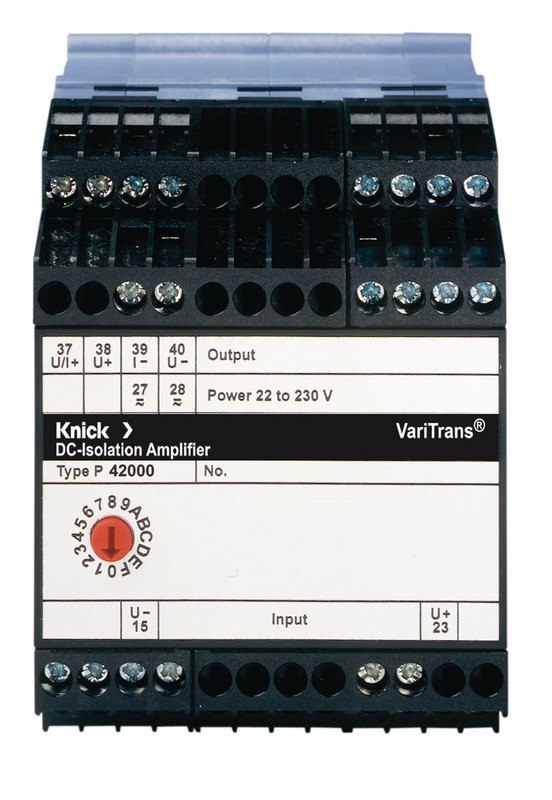
    Knick P42000 high-voltage transducer, DIN-rail housing
    3,600 V working voltageContinuous isolation on the P41000, P42000 and P43000; 4,800 V DC on the P45000 and P52000. Test voltages to 15 kV AC.
    110 microsecondsT90 rise time on the shunt and voltage transducers, 5 kHz cutoff. The controller sees the swell as it happens.
    UL 347 above 1,500 VKnick's UL certificate for the P41000 and P42000 series covers motor controller accessories over 1,500 volts.
    2,165 years MTBFIsolation MTBF from field data, vacuum-encapsulated electronics, five-year warranty.

    Three points on the DC power path

    Same node at each point, only the input wiring and the range change

    AI loads step from idle to full in milliseconds. On the AC side that is sags, swells and harmonics; on the DC side there is no zero crossing, no CT and no PT, so ripple, unbalance and ground faults go unmeasured unless something is built to read them at high potential. Knick's answer is one DIN-rail node, a power supply plus current, voltage and temperature transducers, placed at three boundaries of the 800 VDC power path. Nothing is computed inside it, so every number traces to a raw input.

    AC front end: the converter sees its own input

    An SST or rectifier controller has to see sags, swells and the sine wave itself at control-loop speed, not a meter's averaged reading a cycle later. A voltage transformer and a current transformer feed isolated transducers that hand the controller a hardwired analog signal, no network in the path.

    P29000 voltage transducer, VT input to 600 V. P43000 current transducer, 5 A CT input. P44000 for winding temperature. Isolated to 3,600 V.

    DC bus: the output read independently of the converter

    On an 800 VDC bus the only reading of converter output is usually the converter's own. A shunt and a bus-voltage transducer give the owner kW, kWh and direction from a separate measurement, which is what a settlement figure and a real efficiency number need.

    P41000 current transducer on a 30 mV shunt, 1 A to 20 kA. P42000 voltage transducer, inputs to 3,600 V. Outputs 4 to 20 mA, 0 to 20 mA or 10 V.

    DC load side: alarms beside the breaker, outside the trip path

    Ground faults, pole unbalance and hot joints get found by the breaker if nothing else is watching. Transducers on the feeder shunt, the bus and a Pt100 at bus potential give the protection relay or the RTAC the thresholds to alarm on before the trip, next to the insulation monitor rather than inside it.

    P41000 on the feeder shunt. P42000 on the bus, to 2.2 kV per pole on a plus-minus 400 V system. P44000 temperature at bus potential, isolated to 6,600 V.
    Where it lands beside the other lines: Knick is the OEM's isolated signal inside the converter and the fast alarm beside the insulation monitor. SATEC is the operator's record at the interconnect and on the bus, a Class A power quality meter and the settlement figure. Brainboxes carries both to the DCIM over Modbus TCP, and Schaltbau is the contactor the Knick signal commands. See the whole building on our data center page.

    Measured where kiloamps step without warning

    Seventy-five years of galvanic isolation, now on the data center bus

    Knick did not arrive at high-voltage DC with the AI rack. Its transducers have been on traction busbars, furnace shunts and battery test benches for decades, and that pedigree is the reason a data center owner, a converter builder or a storage integrator can put them on a new 800 VDC design without a qualification program of their own.

    Rail and DC traction

    Traction substations take medium-voltage AC in and put 750 V to 3 kV DC on the busbar, with kiloamp steps on every acceleration and regeneration on every brake. Knick transducers measure those busbars today, qualified to rail insulation coordination and rolling-stock standards.

    Rated for DC railway systems to 3,000 V DC. P45000 to EN 50155:2021 and EN 45545; EN 50124-1 insulation coordination. The isolation built for 3 kV traction is well above an 800 V bus.

    Energy storage, battery test and electrolyzers

    A battery cycler or a pack test bench needs bipolar current over years of cycles; an electrolyzer or fuel cell stack needs its voltage read at stack potential, and the P45000 is built for SIL 2 systems, SIL 3 redundantly.

    P45000: inputs to 3,000 V, measurement to 3,900 V DC, reinforced insulation to 4,800 V, 10 kHz cutoff, minus 40 to 85 degrees C, IEC 61508. Knick cites battery cycler testing in a HIL configuration for the P42000.

    Switchgear and high-speed DC breaker protection

    Electric arc furnaces push tens of kiloamps through shunts in 4.8 kV environments, and a high-speed DC breaker needs its current reading in microseconds. The same shunt-and-transducer pair protects an 800 VDC busway or a STATCOM phase.

    Shunts to 20 kA, class 0.1 to 0.5. CMRR above 150 dB. Fast transients withstood to 20 kV. Knick quotes per-phase current to the trip in under 70 microseconds on STATCOM protection.
    Who we are talking to: the builders of solid-state transformers, rectifier power blocks and sidecar power racks; coolant distribution and storage integrators; switchgear and DC breaker makers; test bench and battery cycler builders; and the owner's electrical engineers who want a reading the converter vendor did not compute. If you have a measuring point on a bus above 600 V, send us the position, the rating and what it reports to.

    What Knick builds

    Transducers and isolators for the high-potential signal, in five families
    Knick P42000 high-voltage transducer
    01

    High-voltage voltage transducers

    Direct voltage measurement at high potential, calibrated and switchable, with the isolation rated for the bus itself rather than a divider in front of a low-voltage input.

    • P42000: 100 V to 3,600 V inputs, 16 calibrated switchable ranges, gain error under 0.3 percent
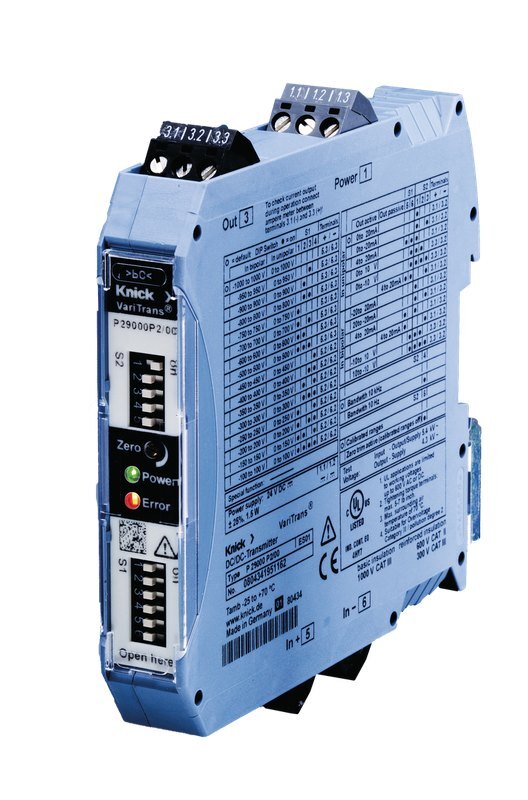
    • P29000: to 1,000 V, voltage with current via shunt on one unit
    • P45000: SIL 2 and SIL 3, to 3,000 V inputs, 4,800 V reinforced insulation; P52000 to 4,800 V
    See the products at Knick
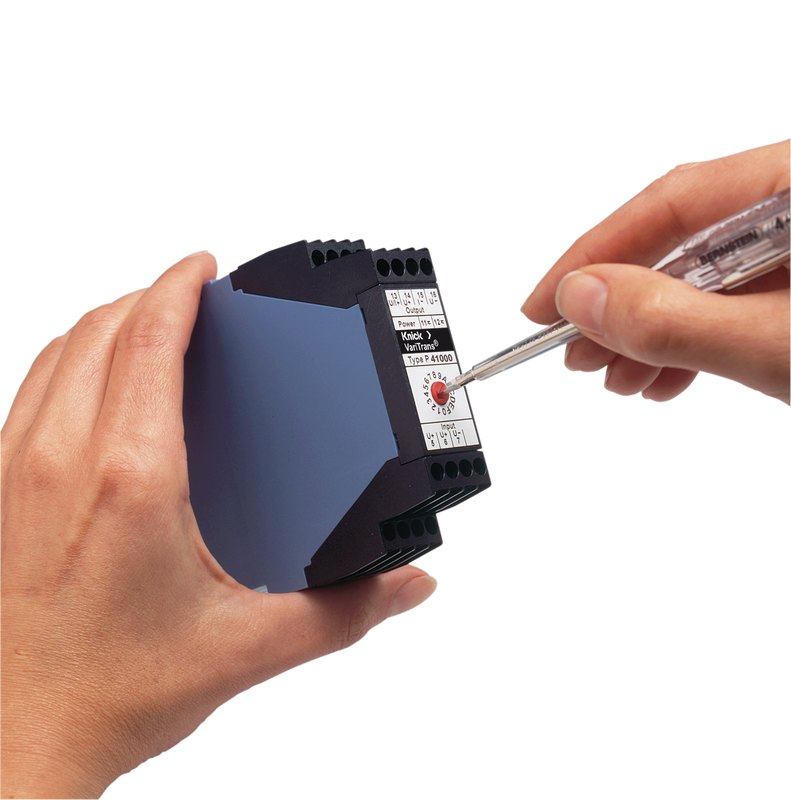
    Knick P41000 high-voltage current transducer
    02

    Current via shunt at high potential

    The shunt sits on the bus, the transducer sits beside it at bus potential, and the controller gets an isolated 4 to 20 mA or 10 V signal.

    • P41000: 50 mV to 100 V shunt inputs, gain error under 0.1 percent, 3,600 V working voltage
    • P43000: current on high potential from a 5 A CT
    • maconic shunts from 1 A to 20 kA, class 0.1, 0.2 and 0.5; TRMS versions for AC currents
    See the products at Knick
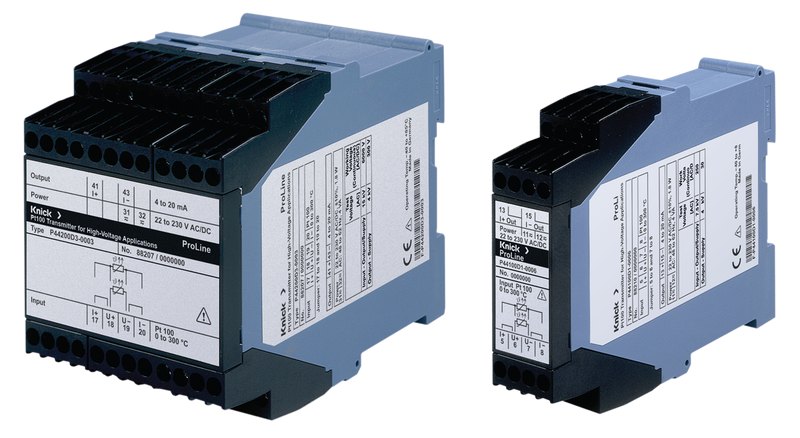
    Knick P44000 temperature transmitter with high insulation
    03

    Temperature at bus potential

    A Pt100 clamped to a joint or a busbar reads the hot spot before it becomes a fault, with the sensor at bus potential and the output isolated from it.

    • P44000: Pt100 input, isolation to 2,000 V or 6,600 V
    • Joint temperature trend for the DC load side, winding temperature for the converter
    • Plus or minus 0.5 K per Knick's application sheet
    See the products at Knick
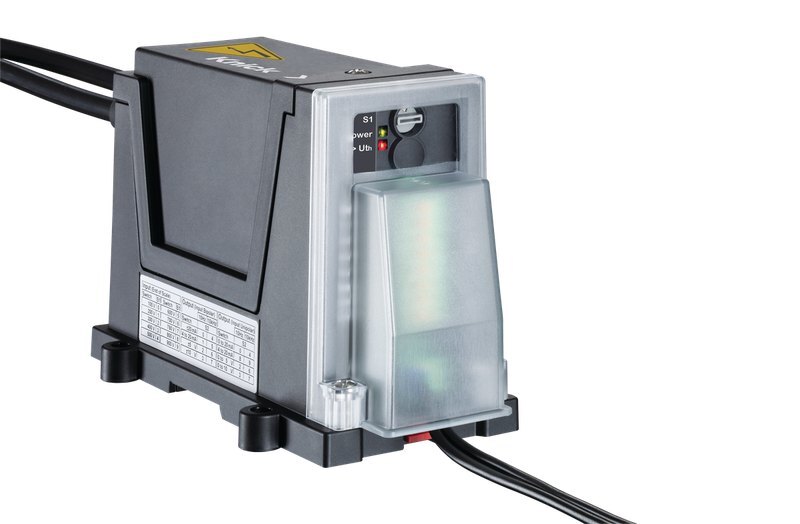
    Knick ProLine isolated signal conditioner
    04

    Isolated signal conditioners

    The standard-signal side of the line: isolation, conversion and transmission of 4 to 20 mA and 10 V signals in the panel, calibrated and switchable, with the broad-range supply.

    • P27000: current and voltage, 480 calibrated switchable ranges, 1,000 V isolation
    • P15000 and A26000: standard signal transmission and conversion, 1,000 V isolation
    • P22400: loop-powered isolation for safety circuits to SIL 3; BL500 series where cost sets the spec
    See the products at Knick
    Knick P52000 VPD high-voltage transducer and voltage monitor
    05

    TRMS and voltage monitoring

    True-RMS versions of the transducers for AC quantities on the same isolation, and a voltage monitor that gives a voltage-free message when the bus is dead.

    • P41000, P42000 and P43000 TRMS: true-RMS AC current and voltage to 3,600 V isolation
    • P52000 VPD: voltage monitor to 4,800 V with a voltage-free message
    • P41000AG: current and overcurrent measurement on one unit
    See the products at Knick

    Also from Knick: signal multipliers, loop-powered isolators, repeater power supplies for Ex and HART loops, digital indicators, and the railway transducer range. The process analytics business (pH, conductivity) is not part of what Dynamic represents.

    The engineering behind it

    Why the isolation holds where a divider or an off-the-shelf isolator does not
    15 kV test voltage10 or 15 kV AC type test on the high-voltage families, 18 kV on the P45000.
    20 kV fast transientsWithstood on the P41000 and P42000; protective separation to 1,800 V per EN 61140.
    CMRR above 150 dBCommon-mode rejection on the shunt transducer, so the kilovolt the shunt sits on does not reach the signal.
    16 switchable rangesCalibrated switching of input and output ranges, plus customer-specific ranges on request.
    22 to 230 V AC/DC supplyOne broad-range supply across the families, on the same DIN rail as the transducers.
    Vacuum encapsulatedMechanically stable for ships, rail vehicles and land craft; minus 10 to 70 degrees C, minus 40 to 85 on the P45000.

    Questions engineers ask us

    Straight answers on high-voltage measurement
    How do you measure an 800 VDC bus for a meter or a controller?

    With a transducer whose isolation is rated for the bus. Knick's P42000 takes bus voltage directly on inputs from 100 V to 3,600 V, and the P41000 reads current from a shunt at bus potential, both with 3,600 V working voltage and an isolated 4 to 20 mA or 10 V output. A resistive divider in front of a low-voltage input is not an isolated measurement.

    What does a transducer add in front of a power quality meter on a DC bus?

    Isolation and headroom. The meter's input sees a scaled, isolated signal instead of the bus itself, so a swell to 1,000 V on an 800 V system is read rather than survived, and a bus above the meter's direct input rating can still be metered. The meter keeps the record; the transducer keeps the bus out of the meter.

    How fast does a Knick transducer respond?

    The P41000 and P42000 have a T90 rise time of about 110 microseconds and a 5 kHz cutoff, with lower cutoff frequencies on request; the P45000 has a 10 kHz cutoff. That is control-loop speed for a solid-state transformer or a high-speed DC breaker, where Knick quotes per-phase current to the trip in under 70 microseconds.

    Can the same transducer be used on an electrolyzer or a fuel cell stack?

    Yes. The P45000 reads stack voltage at stack potential on inputs to 3,000 V with 4,800 V reinforced insulation, and it is built for SIL 2 systems and, used redundantly, SIL 3 under IEC 61508. Knick names hydrogen electrolyzers and fuel cells among its applications.

    Which Knick parts are UL listed?

    Knick publishes a UL certificate for the P41000 and P42000 series under UL 347, the category for motor controller accessories over 1,500 volts, and UL and UL Canada certificates of compliance for the P45000 series. Ask us for the certificate numbers for the part you are specifying.

    Who supports Knick Interface in Northern California and Nevada?

    Dynamic Measurement and Control Solutions represents Knick Interface in Northern California and Northern Nevada. Knick Interface LLC in Huntington Beach, California, handles sales and service for North America and ships from Ohio; we work the measuring point with you and with Knick's application engineers.

    Industries we measure

    Where an isolated reading at high potential earns its keep
    Data centers and digital infrastructureThe AC front end, the 800 VDC bus and the load side, read independently of the converter.Energy, power and electrification systemsBattery storage, electrolyzers, fuel cells and the DC switchgear between them.Rail, transit and transportationTraction substation busbars from 750 V to 3 kV DC, rolling-stock transducers to EN 50155.Semiconductor and test equipmentBattery cyclers, HIL benches and tool power where the bus is above a direct input.Heavy equipment, mobile machinery and outdoor systemsPack voltage and current on electric work machines, vacuum encapsulated for the ride.Industrial automation and production equipmentIsolated signal conditioners and repeater supplies in the control panel.Building, facility and site systemsHot-joint and ground-fault alarms on the DC distribution the building is adding.Life sciences, medical and laboratory equipmentIsolated standard signals for instruments that cannot share a ground.

    The rest of the measurement path

    Knick reads the bus. These lines record it, carry it, break it and make it.
    SATECThe record: Class A power quality and DC metering at the interconnect and on the bus.BrainboxesThe network: transducer, meter and alarm data to the DCIM over Modbus TCP.SchaltbauThe break: DC contactors that open the bus the Knick signal is watching.Premium PSUThe conversion: AC to 800 VDC shelves, DC/DC and inverters off the bus.

    See every line in design order on the design path, or the whole line card on the products page.

    Line cards for the systems Knick measures

    • Data center line card
    • Energy systems line card
    • Utility, substation and grid line card
    • Transportation line card
    • Semiconductor and test equipment line card
    • Test bench line card

    Every Dynamic download

    Pick the position. We set the ranges.

    Send the measuring point, the bus rating and what the signal reports to: the SST control unit, a DC meter, a protection relay or the DCIM. We come back with the parts, the range settings and a wiring sketch, from catalog transducers to a tested node with supply, shunts and terminal plan ready for the cabinet.

    Send us the measuring point

    ×

    Send us the measuring point

    The position on the bus, its rating, and what the signal reports to. Only email is required.

    • Contact Us
    • About Us
    • Our Story
    • Partner with Us
    ©2026 DMCS® -  All rights reserved. Privacy
    Dynamic Measurement and Control Solutions, LLC