
Dynamic Measurement and Control Solutions
    • Products
    • Solutions
      • Design Once, Build Many
      • Power That Performs
      • Machine Intelligence & Control
      • Industrial Data Pathways
      • Wired to Last
      • Thermal Control & Enclosure Systems
    • Applications
      • Industrial Automation & Production Equipment
      • Energy, Power & Electrification Systems
      • Food, Beverage & Process Equipment
      • Transportation, Mobility & Vehicle Systems
      • Life Sciences, Medical & Laboratory Equipment
      • Heavy Equipment, Mobile Machinery & Outdoor Systems
      • Data Centers & Digital Infrastructure
      • Commercial, Self-Service & Public-Use Equipment
      • Building, Facility & Site Systems
    • The Detail
    Dynamic Measurement and Control Solutions
    Opens mobile navigation.

    Click to call. 4087809190

    • Products
    • Solutions
      • Design Once, Build Many
      • Power That Performs
      • Machine Intelligence & Control
      • Industrial Data Pathways
      • Wired to Last
      • Thermal Control & Enclosure Systems
    • Applications
      • Industrial Automation & Production Equipment
      • Energy, Power & Electrification Systems
      • Food, Beverage & Process Equipment
      • Transportation, Mobility & Vehicle Systems
      • Life Sciences, Medical & Laboratory Equipment
      • Heavy Equipment, Mobile Machinery & Outdoor Systems
      • Data Centers & Digital Infrastructure
      • Commercial, Self-Service & Public-Use Equipment
      • Building, Facility & Site Systems
    • The Detail

    Let's get in touch

    Fill out this form, and we'll contact you soon.

    celduc relais logo


    Celduc: Solid State Relays Built for Heaters and High-Cycle Loads


    Zero-cross SSRs that switch an electric heating element every few seconds for years, diagnostics that tell the PLC when an element has gone open, and DIN-rail versions with the heatsink already sized. Celduc relais has designed and built its own relays in Sorbiers, France since 1964, more than a million a year. Dynamic represents the line across Northern California and Northern Nevada with local sizing, thermal and application support for machine builders.

    E-mail us about Celduc


    THE SSR IS SIZED AT DESIGN TIME, NOT ON THE BENCH

    On paper an electric heater is the easiest load there is: resistive, power factor close to 1, no inrush worth mentioning. In practice it is the load that wears out contactors. Temperature control means the switch operates every few seconds, all shift, inside a cabinet that runs hotter than the 40 °C the datasheet assumed, next to drives and power supplies adding their own heat. The contactor that was fine on the prototype is pitting at a few hundred thousand operations. The SSR that was picked on nameplate amps runs hotter than planned and quietly gives up half its life.

    Three things worth knowing before you pick a solid state relay for a heating element, none of which show up on a catalog comparison:

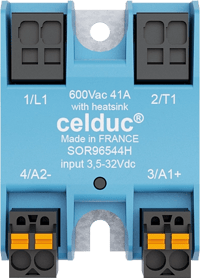
    1. Nameplate amps are not the rating you get. Datasheet current assumes roughly 40 °C ambient and an ideal heatsink. A 40 A SSR with a 1.6 V on-state drop dissipates more than 60 W, and every link in the thermal chain (paste or pad, mounting torque, heatsink, cabinet air) adds resistance; a poor thermal interface alone can double it. Real designs end up 1.5x to 2x oversized against cabinet temperature, not room temperature. Celduc’s celpac SUL and SILD “ready to use” families ship with the heatsink matched to the rating, which takes that calculation off your desk for a large part of the range.


    2. Heaters do have inrush, and they fail open. Utilization category AC-51 assumes a cold-start current of 1.4x nominal, and nickel-chrome elements can draw it. More important, at end of life a heating element almost always goes open circuit, and an ordinary SSR will keep driving nothing while the zone drifts and the product scraps. Celduc’s patented SOD and SILD power SSRs watch the load, the mains and their own output, and signal load loss, mains loss or a shorted output on a potential-free NC contact and an LED, in under 100 ms, with no auxiliary supply. The ESUC module adds the same detection for up to five heaters in parallel on a single celpac.


    3. Every 10 °C costs half the life. That is Arrhenius, and it applies to the thyristor junction. Celduc’s TMS² construction bonds a thick copper layer directly onto an alumina substrate and replaces the copper bridge with multiple bond wires, specifically to cut thermal stress and survive overload current. In accelerated life testing against competing 45 mm relays on the same bench, Celduc SSRs lasted more than twice as long and failed open rather than shorted. We still ask you to design for 20 to 30 °C of junction margin, and we will help you measure it in the real cabinet rather than only calculate it.


    Why DYNAMIC carries CelducCelduc okpac SSR with push-in spring terminals

    A relay is one of the cheapest parts in a heater circuit and the one that decides whether the machine ships with a diagnostics story or a service call. Celduc has made nothing but relays since 1964, designed and built in Sorbiers, France, on automated wire-bonding lines rather than hand-placed copper bridges. We carry it because it is the SSR we can put in a machine builder’s design and stand behind: sized against the real cabinet, checked against the duty cycle, and backed by test data rather than a brochure. Sizing, thermal and approvals questions get answered before the panel is built, not after the first field call.


    WHAT CELDUC MAKES

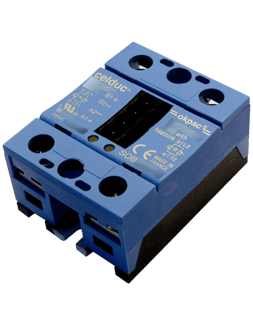
           Celduc okpac SOB9 two-phase solid state relay


    okpac® Single- and Two-Phase SSRs

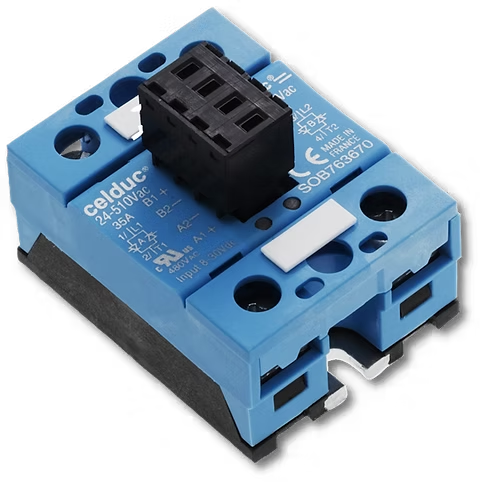
     The 45 mm hockey-puck workhorse. SO9 zero-cross relays for AC-51 resistive loads, 12 A to 125 A, up to 690 VAC, IP20 covers, captive screws or push-in spring terminals (SOBR). Two-phase SOB versions switch a three-phase heater with about a third less dissipation than a three-pole relay.


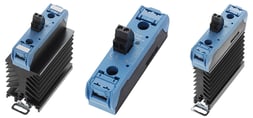
           Celduc SILD power solid state relay with diagnostics and integrated heatsink


    Power SSRs with Heater Diagnostics

     Patented SOD and SILD relays, 35 A to 125 A, that detect load open, mains lost and output shorted, and report on an NC contact and LED with no auxiliary supply. SILD adds an integrated heatsink. ESUC monitors up to five heaters on one celpac; ECOM plugs a thermocouple controller, current monitor and RS485 onto it.


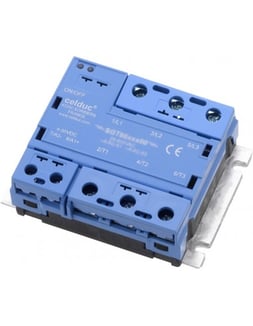
           Celduc cel3pac SGT 2G three-phase solid state relay


    cel3pac® and sightpac® Three-Phase SSRs

     SGT 2G and SGB 2G three-phase relays to 3x85 A and 660 VAC, with screw or push-in spring power terminals to 50 mm² and a pluggable control connector. SMT sightpac puts three poles in the 45 mm footprint, with or without heatsink, for compact heater banks and small motors.


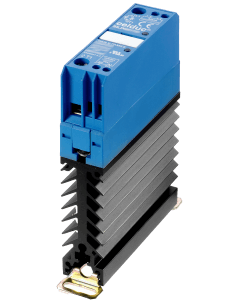
           Celduc celpac 2G SUL DIN-rail solid state relays with integrated heatsink


    celpac® 2G DIN-Rail SSRs with Built-In Heatsink

     22.5 mm wide on a standard 35 mm DIN rail, up to 75 A, wide AC or DC control range and TMS² construction. SUL and SAL “ready to use” versions carry their own heatsink so the thermal calculation is already done; SU versions accept the ESUC diagnostic and ECOM controller plug-ins. The answer for crowded panels and multi-zone heater banks.


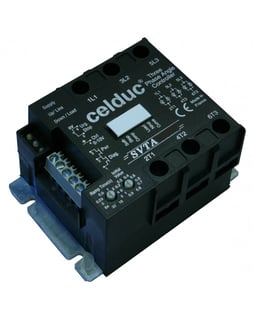
           Celduc SVTA proportional analog-input solid state relay


    Proportional Power and Motor Control

     SVTA and SGTA analog-input SSRs take 0-10 V or 4-20 mA and deliver phase-angle or burst-fire power control at 50 A for heaters that need more than on/off. For inductive loads: SO8 heavy-duty relays with varistor protection, solid state contactors, soft starters and electronic reversing modules to 7.5 kW with no mechanical interlock to wear.

           Celduc magnetic proximity sensors and reed relays


    Magnetic Sensors and Reed Relays

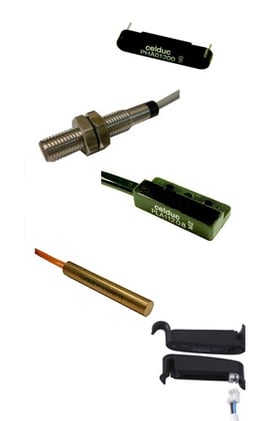
     The product line Celduc started with in 1965. Level and flow sensors, coded-magnet safety sensors to the Machinery Directive, ATEX, PCB, screw-in and tubular position sensors, and reed relays in DIP, SIP and high-voltage packages. They ride along on most Celduc orders, and we stock and support them the same way.


    WHERE IT FITS

    • Packaging, sealing and thermoforming. Seal bars, heater bands and hot-wire cutters cycle every few seconds. Zero-cross okpac SSRs give tight time-proportioning with no contact wear and no acoustic noise, which is why a mechanical relay in that spot is a wear item and an SSR is not.

    • Industrial ovens, furnaces, dryers and process heat. Multi-zone banks of resistive elements. Two-phase SOB relays on delta-connected heaters cut dissipation; SOD and SILD diagnostics flag a dead element before the zone drifts; ESUC watches five in parallel from a 22.5 mm slot.

    • Semiconductor, life-science and lab tools. Chamber, chuck and line heaters where a failed element is a lost lot. The diagnostic contact goes straight to the PLC, celpac 2G fits the crowded enclosure, and DC SSRs handle 24 V and 48 V heater rails.

    • Food and beverage equipment. Fryers, kettles, tunnel ovens and hot-fill lines: silent switching, no arcing, and an IP20 cover between the terminals and the person washing down the panel.

    • EV charging, BESS and DC systems. DC SSRs to 1700 VDC and 150 A, and the SMI series with a live status output. The DC story is on our Celduc unique products page.

    • Doors, elevators, level and safety interlocks. Where the magnetic sensors and reed relays fit, usually alongside the relay order rather than instead of it.


    WHAT A CONVERSATION LOOKS LIKE

    Bring us the heater schedule, the cabinet drawing, or just the part number of the contactor you are replacing. We will talk through:
    • The load: element type, current per phase, cold inrush, delta or wye, and whether one, two or three poles need to switch.

    • The control: cycle time from your temperature controller, zero-cross or phase-angle, and 0-10 V or 4-20 mA if you need proportional power.

    • The thermal chain: real cabinet temperature, heatsink and interface, and whether an integrated-heatsink celpac or SILD removes the calculation entirely.

    • Diagnostics: what the PLC should know when an element opens, and whether that is an NC contact, a status output, or ESUC and ECOM over RS485.

    • Protection and approvals: semiconductor fuses, varistors, UL and cUL for the panel, and the high-limit contactor in series that still belongs in the design.

    You walk away with a part number, a heatsink, and a derating number you can defend. If a contactor is the right answer for your duty cycle, we will say so.

    SOLID STATE RELAYS FOR HEATERS: QUESTIONS WE GET

    Can I use a solid state relay to switch an electric heating element?
    Yes, and it is the ideal case. A resistive heater (utilization category AC-51) has no power factor problem and no motor-style inrush. Use a zero-cross SSR, size it for the 1.4x cold-start current the AC-51 standard assumes and for the real cabinet temperature, and mount it on a heatsink chosen for the watts it will dissipate, not for the hole pattern.

    SSR or contactor for a heater?
    If the temperature controller cycles the heater more than every few minutes, or runs a time-proportioning output, use an SSR; a contactor in that position is a wear item that pits, chatters and eventually welds. Keep a contactor in series as the high-limit safety break, because an SSR is not an isolating device and a shorted thyristor will keep the heater on.

    Why does my solid state relay run hot?
    Because it is supposed to: the on-state voltage drop turns roughly 1 to 1.5 W of every amp into heat, so a 40 A relay can produce over 60 W. The datasheet rating assumes about 40 °C ambient and an ideal heatsink. A missing thermal pad or paste, a heatsink chosen for its size, or a cabinet that runs hot from drives and supplies pushes the junction toward its limit, and every 10 °C rise roughly halves the life.

    Do solid state relays fail open or shorted?
    Thyristor SSRs commonly fail shorted, which is exactly why the high-limit contactor stays in the design. In Celduc’s comparative accelerated life test its relays failed open rather than shorted, and the SOD and SILD diagnostic families report a shorted output on a normally closed contact so the PLC can act on it rather than discover it.

    How do I detect a failed heating element?
    With an ordinary SSR you find out when the zone temperature drifts and the product scraps. Celduc SOD and SILD power SSRs detect load loss, mains loss and a shorted output in under 100 ms and signal it on an NC contact and an LED with no auxiliary supply. The ESUC module monitors up to five heaters in parallel from one celpac, and ECOM adds current monitoring, a thermocouple input and RS485.

    Are Celduc SSRs suitable for UL 508A panels?
    Most Celduc SSR families carry UL and cUL recognition and CE marking, and the SU and SA celpac ranges also meet EN 61373 for shock and vibration. We confirm the specific listing and the required semiconductor fuse against your panel’s UL 508A requirement at quote time rather than in the field.

    GO DEEPER ...

    Unique products, the full SSR range by pole count, and Celduc's own datasheets and catalogs:

    Celduc unique products Solid state relays by type Power SSRs with diagnostics Celduc catalog and datasheets

    Request Celduc Samples

    Recent Posts on Solid State Relays

    feature image
    Jeff Weseloh
    Scaling Packaging Production? Here's How Dynamic Helps
    You're not building one-off automation cells; you’re building packaging and sealing machines for production lines, churning out thousands of units...
    Read More

    feature image
    Dynamic Measurement and Control Solutions, LLC
    Power Cooling: Role of Heat Sinks in Zero-Crossing Solid State Relays
    Solid state relays (SSRs) have become increasingly popular in electrical systems due to their numerous advantages over traditional electromechanical...
    Read More
    feature image
    Dynamic Measurement and Control Solutions, LLC
    Ultimate Guide: When's the Right Time to Upgrade to Solid State Relays
    Solid State Relays (SSRs) have revolutionized the field of electrical switching, providing numerous advantages over traditional electromechanical...
    Read More
    feature image
    Dynamic Measurement and Control Solutions, LLC
    Solid State Relay with Fieldbus Interface: Revolutionizing Automation
    In the era of IIoT and Industry 4.0, solid-state relays (SSRs) have become an essential component for various industrial applications. These devices...
    Read More

    • Contact Us
    • About Us
    • Our Story
    • Partner with Us
    ©2026 DMCS® -  All rights reserved. Privacy
    Dynamic Measurement and Control Solutions, LLC