 UL 508A is the standard a panel shop builds to and the label an inspector looks for on an industrial control panel. It is also where a lot of otherwise solid machine designs get stuck: a supplementary protector where a breaker belongs, a drive without the fuses its listing calls for, a 5 kA short-circuit current rating shipped to a plant with 35 kA available. This post covers what UL 508A actually governs, the misapplications that reject panels most often, and how to get it right before the build starts.
What UL 508A is
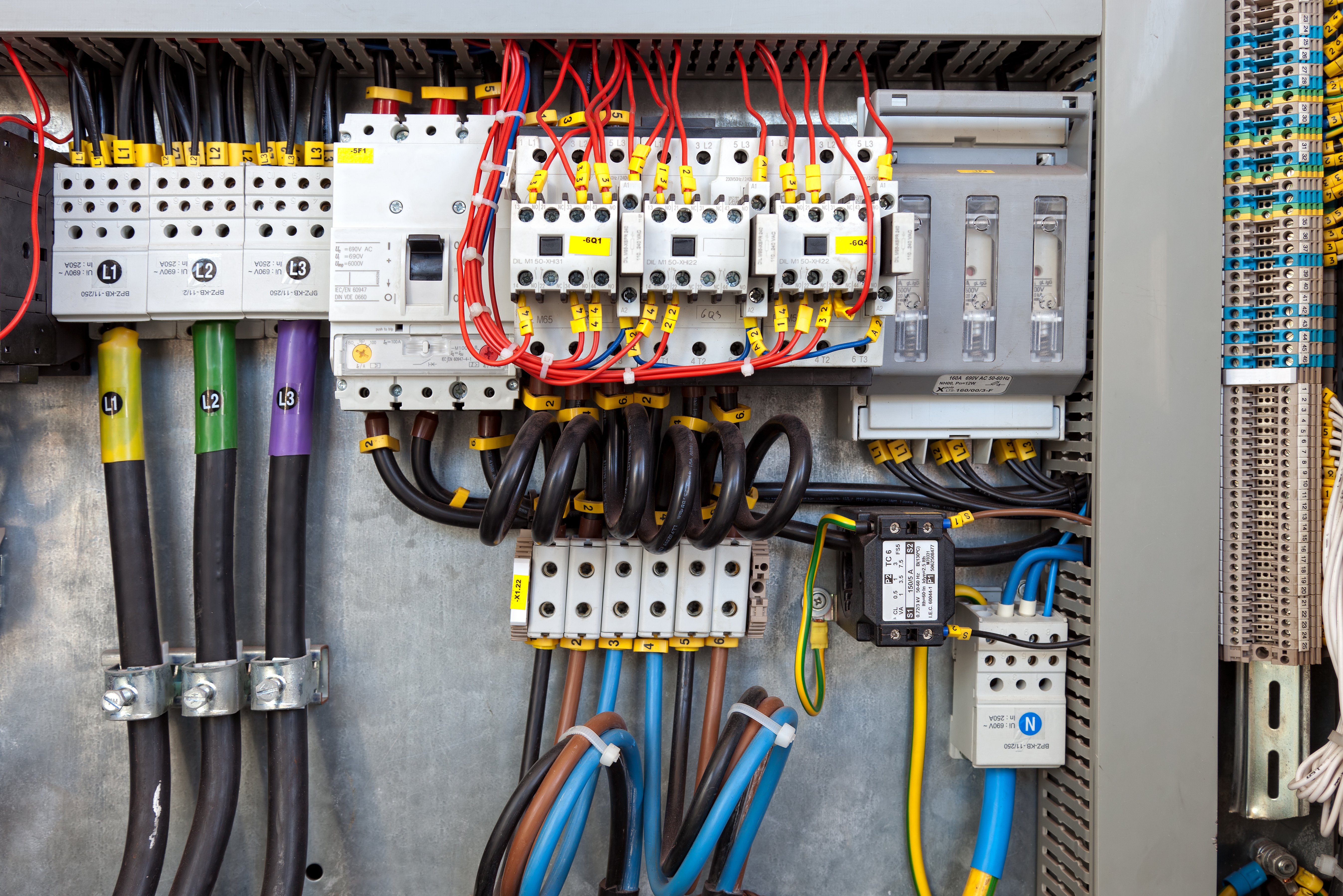
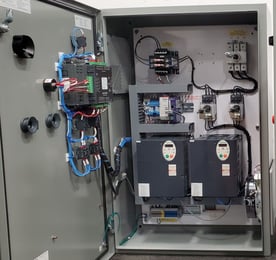
UL 508A is the Standard for Safety for Industrial Control Panels. The National Electrical Code defines an industrial control panel in Article 409 as an assembly of two or more power circuit components, control circuit components, or a combination of the two: contactors, overload relays, drives, transformers, terminal blocks, overcurrent protective devices, and the like, mounted in an enclosure. UL 508A tells you how those parts have to be selected, protected, spaced, wired, and marked so the assembly can be Listed as a whole.
The important point is that UL 508A is a construction standard for the panel, not a certification for the parts inside it. A panel shop with a UL 508A procedure builds to the standard, applies the UL Listed Mark, and is audited under UL's Follow-Up Service. The finished panel then satisfies NEC Article 409 and the approval requirements of NEC 110.2 and 110.3(B), which is what the Authority Having Jurisdiction (AHJ) needs to sign off. For panels going to Canada the parallel standard is CSA C22.2 No. 286, and a cUL Listing under 508A covers it.
The most common ways panels fail
UL's own list of the ten most common challenges in building industrial control panels matches what we see in the field:
- Applying the wrong standard to a component
- Selection and sizing of components
- Supplementary protection where branch circuit protection is required
- Enclosure Type rating not maintained
- Power supplies: Recognized versus Listed, industrial versus Class 2
- Missing or incomplete nameplate, diagram, and warning markings
- Wire and cable without traceable certification
- Variable frequency drives protected incorrectly
- Feeder and branch circuits mixed up
- Short-circuit current rating wrong or missing
Most of these share a root cause: a component that carries a UL mark, but not the right one for the job it was given. The sections below take the ones that cause the most trouble.
Selecting and sizing components
 Two similar-looking parts from the same catalog can carry different certifications. One is UL Listed as a complete device. The other is a UL Recognized Component, evaluated only for use inside other equipment and shipped with Conditions of Acceptability that spell out the enclosure, ambient, spacing, wire range, and overcurrent protection it needs. Supplement SA of UL 508A lists, category by category, which component standard a part must be certified to and whether a Recognized part is acceptable in that position. Supplement SB covers how those choices add up to the panel's short-circuit current rating.
Spacings are the second problem. UL 508A specifies minimum through-air and over-surface distances between live parts of opposite polarity and to grounded metal, and those distances depend on the circuit voltage. A layout that looked fine in CAD can fail on the bench because a Recognized terminal block or a field-wiring lug was applied outside its evaluated spacing.
The fix is to settle both at design time. UL's Manufacturer's Technical Representative (MTR) program trains a designated person at the panel shop to make these calls and document them. If you do not have an MTR on staff, Dynamic can review the bill of materials and layout before the enclosure is drilled.
Branch circuit protection versus supplementary protection
A miniature circuit breaker certified to UL 1077 is a supplementary protector. It is a Recognized Component, it has not been evaluated to serve as the sole protection for a circuit, and it cannot be used as branch circuit protection no matter how it is labeled in the catalog. Branch circuit protection in a 508A panel has to be a Listed device: a circuit breaker to UL 489 or fuses to UL 248. UL 1077 devices belong downstream of that protection, guarding a control circuit or a single load, within the limits of their Conditions of Acceptability. Feeder and branch circuits get mixed up the same way: their conductors and protection are sized by different rules, and a feeder tap treated as a branch circuit fails the review. Our post on when to apply UL 489 devices goes into the details.
Enclosures and Type ratings
An IP rating is not a Type rating. IEC enclosures are classified by IP code. North American enclosures are classified by Type under UL 50E and NEMA 250, and NEC 110.28 requires the Type to match the installation environment. The two systems do not translate: an IP66 box is not a Type 4X box until it has been evaluated and marked as one. In a 508A panel the enclosure must be UL Listed, and its Type has to suit the location. Type 1 and Type 12 cover general and dust-tight indoor use, Type 3R and Type 4 cover outdoor use, and Type 4X and 6P cover corrosion and temporary submersion.
Every hole cut in that enclosure is a chance to lose the rating. Pushbuttons, pilot lights, HMIs, cable glands, vents, and disconnect handles must each be certified to maintain the Type of the enclosure they are mounted in, and the marking on the component has to say so. Section 19 of UL 508A, summarized in Tables 19.2 and 19.3, lists which component markings satisfy which enclosure Type.
Power supplies
A 24 V DC supply is either Listed as a complete unit or Recognized with Conditions of Acceptability, and it is either a Class 2 source or it is not. A Class 2 output, certified to UL 1310 or UL 5085-3, lets the control circuit be wired under the Class 2 rules of NEC Article 725. An industrial supply Listed to UL 508 or another industrial standard is not Class 2 unless its marking says so, and its output circuit needs overcurrent protection and conductors sized as an ordinary control circuit. Mixing these up is one of the most common corrections on a first inspection.
Variable frequency drives
A drive's listing specifies the overcurrent protection it was tested with: a particular fuse class and size, a specific breaker, or both at different fault levels. The drive's short-circuit current rating is only valid with that protection in front of it. Substituting a breaker for the semiconductor fuses the manufacturer tested with, or feeding several drives from one branch device the listing does not allow, invalidates the rating and takes the whole panel's SCCR down with it.
Short-circuit current rating
Every 508A panel must carry a marked short-circuit current rating, and NEC 409.110 requires the marking. Supplement SB sets out the method. The panel's rating is the lowest rating in the power circuit, and any power circuit component without a marked rating is assigned a default from Table SB4.1, many of them 5 kA. A panel marked 5 kA that arrives at a plant with 35 kA available at its terminals cannot be installed (NEC 110.10 and 409.22), and that gets discovered at the site, after the panel is built and shipped. Getting the SCCR right means choosing components with published high combination ratings, using current-limiting fuses or breakers that were tested with the downstream devices, and documenting the calculation before the first part is ordered.
Wire, markings, and traceability
Power and control wiring inside a 508A panel has to be a Listed type such as MTW or THHN/THWN, or Appliance Wiring Material (AWM) used only where UL 508A specifically permits it and only under the conditions in its Recognition. Unmarked cable, or cable whose certification cannot be traced from the reel to the panel, is a rejection waiting to happen. The finished panel also has to carry the nameplate markings the standard requires: manufacturer, supply voltage, phase and frequency, full-load current, largest motor, SCCR, enclosure Type, and the wiring diagram number, plus whatever hazard labels the design calls for. A panel without a diagram number on the nameplate is not complete.
What UL 508A does not cover
UL 508A applies to industrial control panels for general industrial use in ordinary locations. It is not the right standard for:
- Fire pump controllers, covered by UL 218
- Panelboards, covered by UL 67
- Dead-front switchboards, covered by UL 891
- Motor control centers, covered by UL 845
- Panels for hazardous (classified) locations, covered by UL 1203 and related standards
- Panels containing intrinsically safe barriers, covered by UL 698A
- Fire alarm control equipment, covered by UL 864
Applying 508A to one of these is the "wrong standard" problem at the assembly level. The machine wiring outside the enclosure is governed by NFPA 79, not UL 508A. See our post on the NFPA 79 standard.
Why getting it right pays
- Inspection acceptance. A 508A Listed label plus a correct SCCR marking is what the AHJ and the end user's insurer need to see. Without it the alternative is an NRTL field evaluation at the site, on the customer's schedule and your invoice.
- No rework after shipment. Every problem above is cheap to fix on the drawing and expensive to fix in a panel bolted to a machine three states away.
- Customer specifications. Most OEM and end-user specs require UL 508A for the panel and NFPA 79 for the machine. A panel that cannot carry the mark is hard to invoice.
- Liability. A panel built under a UL procedure with a documented SCCR calculation is a very different conversation after an incident than one built the way it has always been done.
UL 508A is not complicated once the decisions are made in the right order: standard, components, protection, SCCR, enclosure, markings. The mistakes come from making them in the wrong order, usually after the parts are already on the shelf. If you want a second set of eyes on a design before the build starts, contact us. For the background on the UL marks themselves, read what a UL certification is and why it matters. You can also stay in touch by signing up for our newsletter or following us on LinkedIn and Facebook.

Dynamic represents power, control, and connectivity lines for machine builders and panel shops in Northern California and Northern Nevada.
Working through a live design question?