DC contactor datasheets lead with the cycle count. It is the first number engineers compare, and it carries an implied weight of reliability that it has not earned. The figure was inherited from AC motor control, and it answers a question that a modern DC power architecture has stopped asking.
How the contactor's job changed
In AC motor control the contactor was the switch. It started and stopped the motor thousands of times between service intervals, endurance cycling was its actual duty, and a high cycle count belonged on the datasheet.
In a battery system, an energy storage rack, a solid-state transformer or a DC fast charger, the routine switching has moved to the power electronics. IGBT and SiC stages switch at kilohertz, millions of times, with no contact wear. What is left for the contactor is three things:
- Hold galvanic isolation when the system is open.
- Carry continuous current at a stable, low contact resistance when it is closed.
- Interrupt a fault when commanded, at the system voltage, with certainty.
Routine switching is not on the list. The contactor is now an isolator and a fault interrupter. The duty changed; the datasheet template did not.
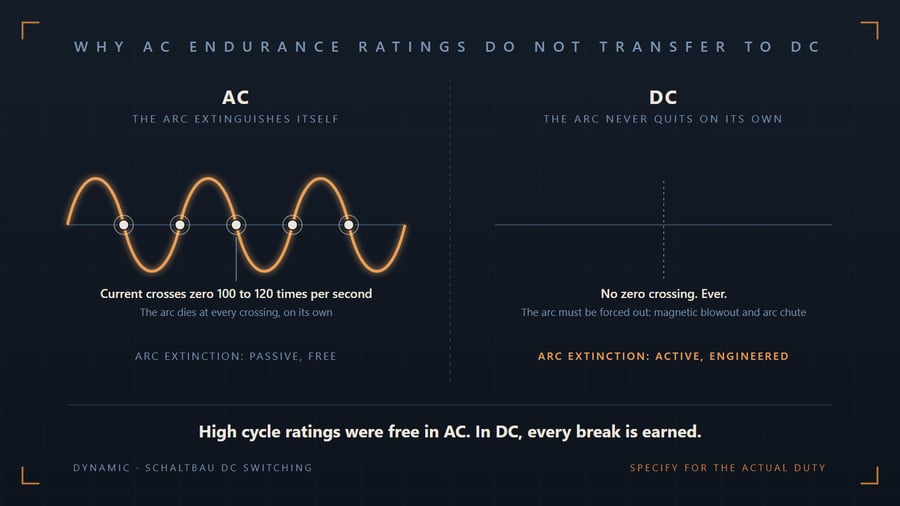
Why AC endurance ratings do not carry over to DC
AC crosses zero 100 to 120 times a second. The arc goes out on its own at each zero crossing, which is why high mechanical endurance is nearly free in an AC air-break design: plain contacts reach large cycle counts with very little arc management.
DC has no zero crossing. The device has to stretch, cool and extinguish the arc itself, every time it opens under load. The high-cycle figures that cost nothing in AC are not achievable under equivalent DC switching, so when the application moved to DC the inherited number stayed on the template without the physics that had made it true. Our companion post, open-air magnetic blowout versus sealed gas-filled DC contactors, goes through how each design puts the DC arc out.
Mechanical life versus break life: the gap on one datasheet
A contactor datasheet can carry two different life ratings, and the distance between them is the whole point.
- Mechanical, or make, life. The number of close operations at almost no arc energy. Structurally easy to reach, so the numbers are large.
- Break life at rated voltage and current. The number of open operations under full load. Governed by arc erosion, so the numbers are far smaller.
A sealed contactor advertising a million mechanical operations may carry two thousand rated-load breaks on the same sheet, a ratio of five hundred to one. For a device whose function is fault interruption, only the break rating means anything. The headline cycle count almost always describes light-load switching, not interruption at fault level.
The governing question is specific: what current can this device interrupt, at your system voltage, under tested and verified conditions?
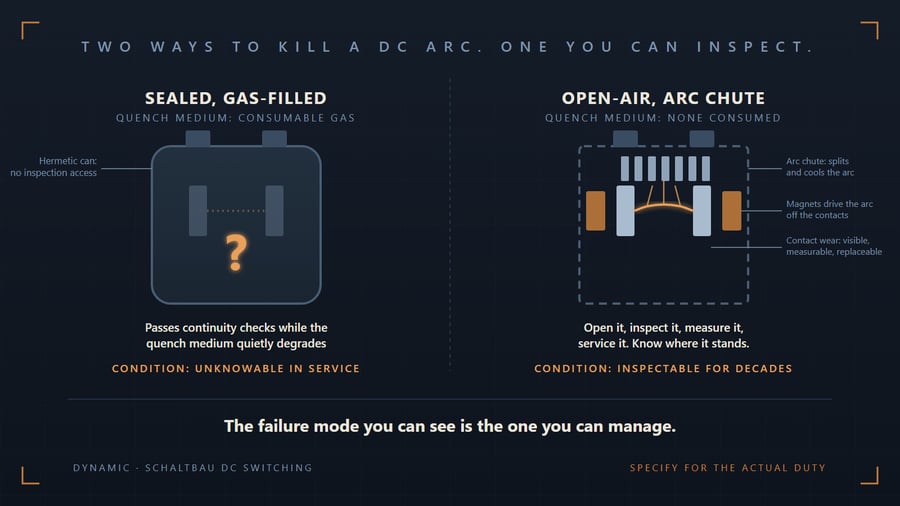
Sealed versus open-air arc management: the failure mode you can and cannot see
Where the contactor sits closed for years and then has to interrupt a single fault, the arc management architecture decides whether the device's condition can be known before that day.
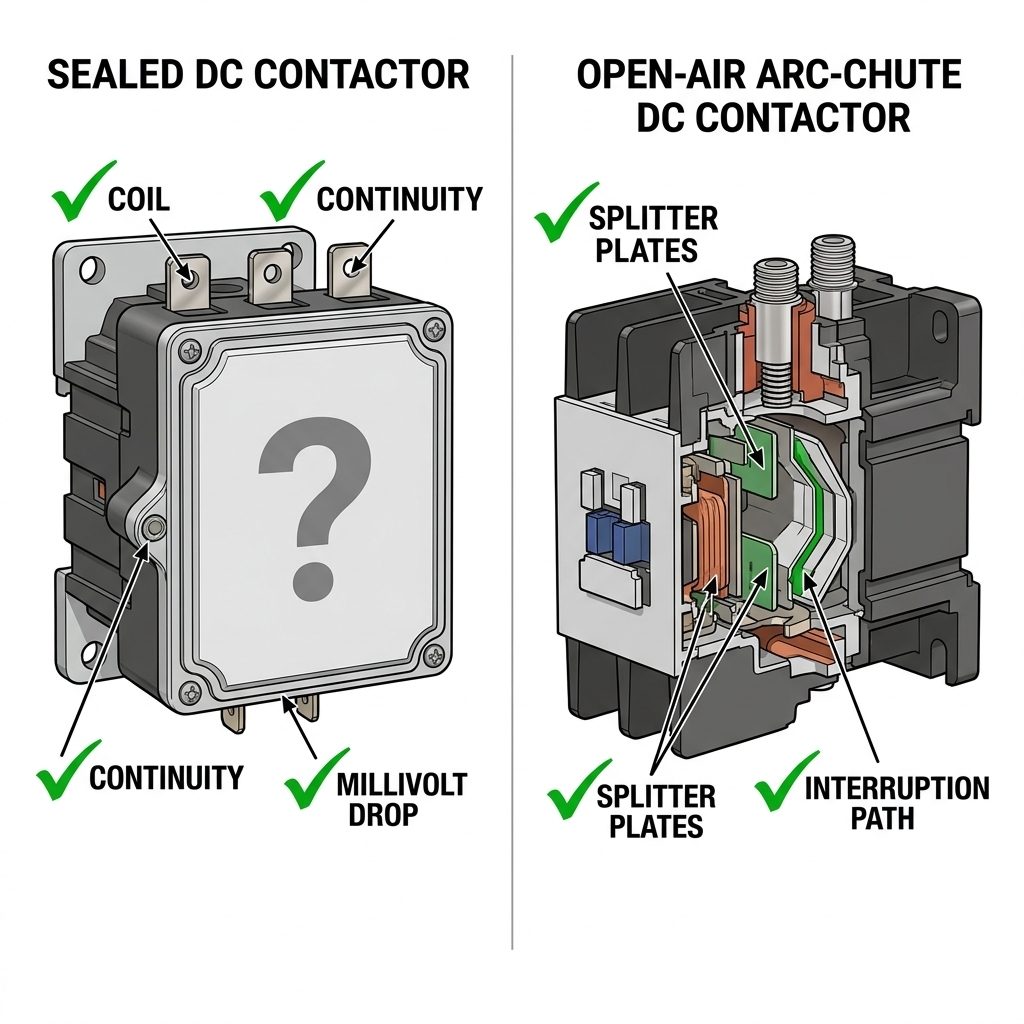
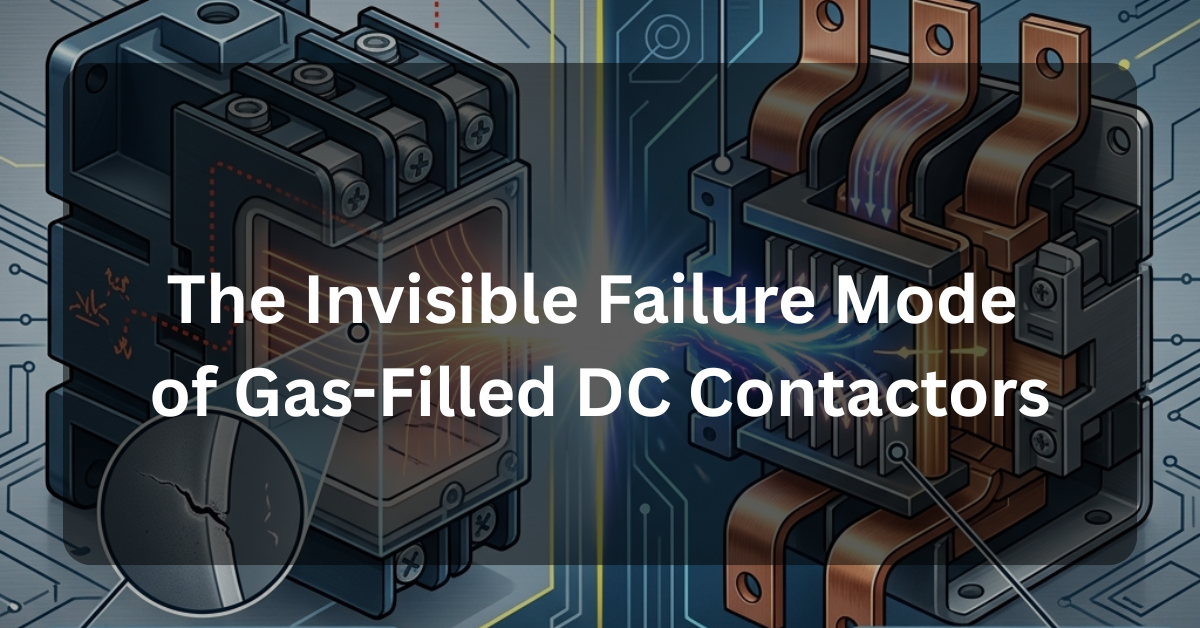
A sealed gas-filled contactor quenches the arc in a sealed charge of inert gas. It is compact and, in the right place, effective. But the contacts and the gas fill age together inside a can that nobody can open. A device that passes a routine continuity check may already have eroded to a point where it can no longer interrupt DC at rated voltage, and there is no external sign of it. The only measurement available from outside is contact resistance, and by the time that moves the margin is gone.
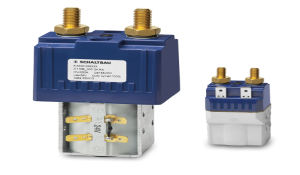
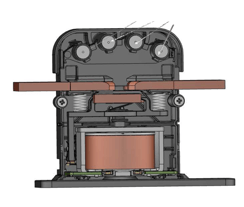 An open-air design with magnetic blowout drives the arc into an arc chute in air, with nothing inside the device that has to be sealed in. The contacts and the chute still wear; that is the physics of interrupting DC. The difference is that the wear is visible. A technician can open the device, look at the tips, measure the erosion and know where the unit stands. On serviceable designs such as the Schaltbau CT and CP series, worn contacts are replaced in place, which resets contact resistance and restores the rated break performance without replacing the contactor. A sealed device offers none of that: when it is spent, the remedy is replacement, and there is no warning that the point has been reached.
For a safety-critical device on a multi-decade installation, inspectability is a functional requirement, not a preference. Every Schaltbau DC contactor is built around an open-air, permanent-magnet blowout architecture for that reason: the device's condition is never a guess.
What the standard actually requires
The assumption that "UL requires 6,000 cycles" mixes up a product certification with a code mandate. That figure is the endurance level a particular product was certified to, not a floor the standard imposes on every DC contactor.
The utilization categories in IEC and UL 60947-4-1 were written around motor switching and manual disconnection. None of them maps cleanly onto a device that carries current continuously and interrupts a single fault. The standard defines how a stated rating is tested; it does not require a DC isolation contactor to meet a motor starter's endurance threshold. Specifying against that assumption spends engineering effort on a characteristic the device is never asked to deliver.
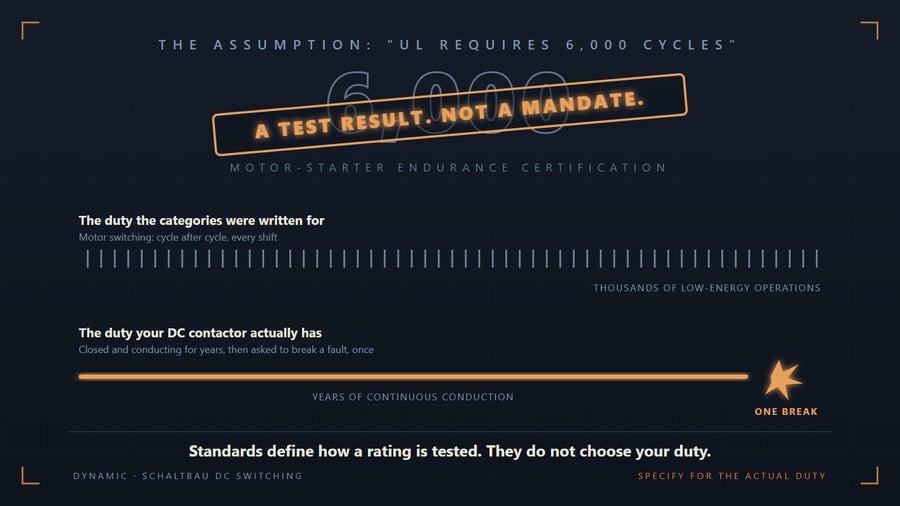
Specifying a DC contactor for its actual duty
When a DC contactor is evaluated first on cycle count, it is being judged against a motor-control criterion that no longer applies. The parameters that govern an isolation and fault-interruption role are:
- Breaking capacity at the maximum credible fault current.
- The interruption curve at rated system voltage and current, in both current directions if the bus charges and discharges through the same device.
- Contact resistance stability over the full dwell period, and whether it can be reset by servicing the contacts.
- Post-fault withstand after an interruption event.
These four decide whether the device performs when it matters. Cycle count describes how well it performs a function the power electronics already handle. Identify what the contactor is actually required to do, then specify to that.
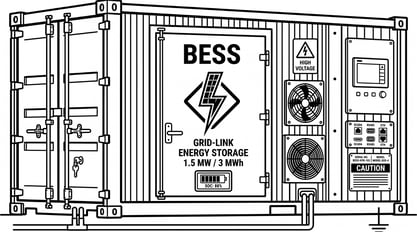 A concrete case. An energy storage system on a 1,000 V DC bus with a credible fault current in the kiloamp range needs a contactor rated to break that fault at that voltage, once, with certainty. Whether the same device can cycle six thousand times at light load says nothing about whether it survives that one event. The break rating at your voltage is the specification. The cycle count is trivia.
Bring the part number
I rep Schaltbau in Northern California and Northern Nevada, and the fastest way to settle this on a real design is to put the two life lines side by side for the part you have now. Send the part number, your system voltage and your fault current, and I will come back with the break rating that applies and whether a Schaltbau contactor changes the answer. The product families are on the Schaltbau DC contactors page, and the one-page Schaltbau at a glance card has the four of them with a photo of each.