
Five products, five problems solved
Two are about heaters, which is where most of our Celduc conversations start. The other three are where Celduc goes and commodity relays don’t.
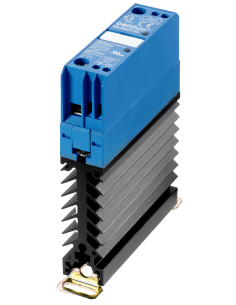
SOD / SILD diagnostic SSRs
35 to 125 A · 50–265 VAC or 150–510 VAC · potential-free NC alarm contact and LED · fault reported in under 100 ms · no auxiliary supply · SILD with integrated heatsink
Patented power SSRs that watch the load, the mains and their own output. A heating element that goes open, a lost phase or a shorted thyristor trips the NC contact, and that contact lands on a PLC input.
Why it matters. A heating element almost always fails open. With an ordinary SSR the first sign is a zone that will not hold temperature and a batch that scraps. Here a dead element is an alarm, not a discovery.
How it differs. The usual answer is a separate current monitor, a CT, an auxiliary supply and the wiring between them. This is one relay with the detection built in, sized for real heater currents.
Power SSRs with diagnostics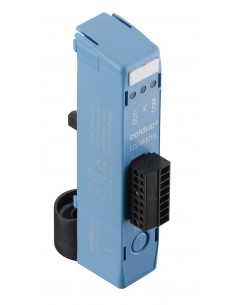
ECOM + ESUC plug-ins
Plugs onto celpac 2G SU / SUL relays · thermocouple input · load current monitoring · RS485 · ESUC diagnostics for up to 5 heaters in parallel · 22.5 mm footprint
ECOM puts a temperature controller, current monitoring and a serial interface on the relay’s own footprint. ESUC adds heater diagnostics for up to five elements on the same relay. No extra DIN space, no extra wiring run per zone.
Why it matters. Multi-zone heater banks eat panel space. Putting the loop, the monitoring and the comms on the relay removes a controller, a transducer and their wiring for every zone.
How it differs. The catalog answer is three SKUs per zone and a wiring diagram. We have not found another SSR line where the controller mounts on the relay.
ECOM and ESUC details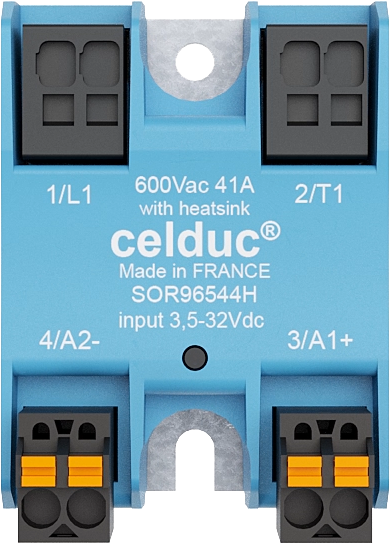
Push-in terminal SSRs
okpac 45 mm form factor · spring-clamp control terminals · push-in power terminals on the SOBR two-phase range · no screwdriver, no torque check, no re-torque after thermal cycling
The current okpac generation with push-in spring terminals in place of screws. The switching function and footprint are standard; the terminal is the differentiator.
Why it matters. The same labor savings push-in brought to terminal blocks, now on the relay. No torque checking at build, no callback for a loose connection after the panel has heat-cycled for a season. Panel shops running repeat builds feel it first.
How it differs. Nearly every other SSR on a distributor shelf is screw-terminal. Push-in on an industrial SSR is a Celduc move.
Push-in terminal range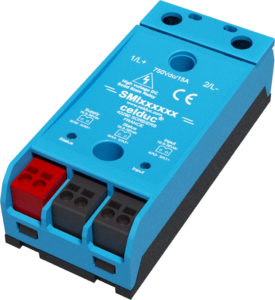
SMI series DC SSR
Up to 750 VDC · 15 A · 45 mm DIN-mount enclosure · built-in short-circuit protection · live status output · 24 VDC control
A packaged high-voltage DC solid state relay for DC resistive loads, with a real-time status output that reports the relay and installation state back to the controller.
Why it matters. Drop-in DC switching for battery storage, EV charging, solar combiners and DC bus heaters, where AC SSRs and electromechanical contactors do not survive. The status output gives the PLC live diagnostics without an external monitor.
How it differs. DC SSRs at this voltage are usually bare IGBT modules: no enclosure, no DIN mount, no feedback. SMI is the finished part.
DC solid state relays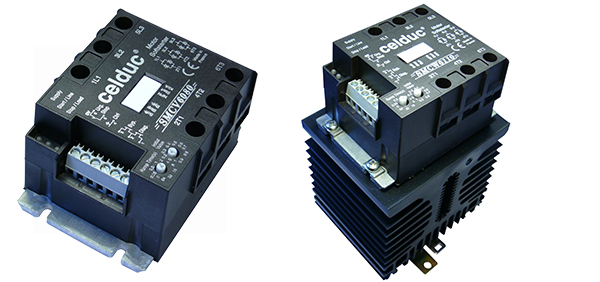
Reversing SSR modules
SG969100 / SGR8671510 / SMR8621520 · three-phase · up to 7.5 kW · electronic interlock · configurable direction-change delay · no moving parts
Three-phase reversing starters in a single solid-state block, with built-in electronic interlocking that cannot energize forward and reverse together, plus a fixed or configurable delay between direction changes.
Why it matters. No contactors to wear out, no interlock wiring to get wrong, no arc suppression to add. Built for high-cycle reversing: dampers, gates, mixers and indexing conveyors, where electromechanical starters fail early.
How it differs. The commodity solution is two contactors, a mechanical interlock kit and a timer: three SKUs, more wiring, finite life. This is one SKU that cannot be wired wrong.
Motor control SSRsAt a glance
| Product | Form factor | Rating | What it replaces |
|---|---|---|---|
| SOD / SILD diagnostic SSR | 45 mm okpac; SILD with integrated heatsink | 35–125 A, 50–265 or 150–510 VAC, NC alarm contact | SSR + current monitor + CT + auxiliary supply |
| ECOM + ESUC plug-ins | Plug-on to 22.5 mm celpac 2G SU / SUL | Thermocouple control, current monitoring, RS485; ESUC up to 5 heaters | Temperature controller + transducer + gateway per zone |
| Push-in terminal SSR | 45 mm okpac, SOBR two-phase with push-in power terminals | Standard okpac ratings to 690 VAC | Screw-terminal SSR plus torque checks and re-torque visits |
| SMI series DC SSR | 45 mm DIN-mount, enclosed | 750 VDC, 15 A, status output, 24 VDC control | Bare IGBT module or DC contactor with no feedback |
| Reversing SSR module | Single solid-state block, three-phase | Up to 7.5 kW, electronic interlock, direction-change delay | Two contactors + interlock kit + timer |
The right SSR is an application decision, not a catalog one
Dynamic is the manufacturers’ representative for Celduc across Northern California and Nevada. Bring the load, the cabinet and the cycle rate, and you get back a part number, a heatsink and a derating number you can defend. Sizing, thermal and approvals are settled before the panel is built, not after the first field call.
Celduc overview: SSRs for heaters Solid state relays by type

Speak with a product expert
Jeff Weseloh, Dynamic Measurement & Control Solutions. Engineer to engineer, same day.
Send me a direct e-mail Call me