It depends on where the building is. In California the requirement is Title 24, Part 6, Section 130.5. In Nevada it is the 2024 IECC, Section C405.13. Federal, military, LEED and most out-of-state work cite ASHRAE 90.1, Section 8.4.3. Each one names a threshold, a list of load categories, a recording interval and a retention period, and those four things set the metering schedule.
The rest of this page walks through the three, side by side, in the order a specifier needs them: which one applies, what it asks for, and what that means on the panel schedule and the one-line.
Start with the permit, not the standard
The question we get is usually "the plan checker says this job needs energy metering by end use, which code is that?" The answer is set by the jurisdiction and the permit date, so settle those first.
- California. Title 24, Part 6 is the energy code, and Section 130.5 is the metering section. California does not adopt ASHRAE 90.1 or the IECC as its commercial energy code. The 2025 edition applies to permit applications filed on or after January 1, 2026; a permit filed earlier is on the 2022 edition, which carries the same section.
- Nevada. The Governor's Office of Energy adopted the 2024 IECC statewide, effective August 18, 2024, with revisions effective March 12, 2025. The metering section is C405.13. Cities and counties enforce it and may adopt stricter provisions, so confirm which edition the building department is applying on a Reno, Sparks, Carson City or Washoe County permit. A job filed under the prior cycle carries the 2021 numbering, C405.12, with a higher threshold.
- Everywhere ASHRAE 90.1 is the basis. Federal and Department of Defense projects, LEED, states that adopt 90.1 as their commercial code, and any IECC project designed on the ASHRAE 90.1 alternative compliance path. Section 8.4.3 is the metering section; the current edition is 90.1-2022, and an addendum approved in 2025 tightened the interval wording.
Two of the three are closer than they look. The IECC and ASHRAE 90.1 both ask for metering by end-use category with a data system behind it. Title 24 asks a different question: what is metered at each service and feeder, and whether the distribution system is laid out so load types can be measured separately at all.
What each one actually requires
The table is the short version. Section numbers are given so the plan checker and the owner can read the same text you did.
| Title 24 Part 6, Section 130.5 (California) | 2024 IECC, Section C405.13 (Nevada) | ASHRAE 90.1-2022, Section 8.4.3 | |
|---|---|---|---|
| Trigger | Every electrical service or feeder the permit puts in, at any size, gets a permanently installed meter (130.5(a)). Separation of load types starts above 50 kVA (130.5(b)). | New buildings of 10,000 square feet gross conditioned floor area and up. The 2021 edition, C405.12, set the line at 25,000 square feet. | New buildings of 25,000 square feet and up. Tenant spaces under 10,000 square feet and dwelling units are excepted, as are the Article 517 critical and life-safety branches. |
| What gets measured | Instantaneous kW demand and kWh over a user-definable period at every size; historical peak kW above 250 kVA; kWh per rate period above 1,000 kVA (Table 130.5-A). Load types per Table 130.5-B: lighting, HVAC, water pumps, plug loads, elevators, individual loads of 25 kVA and up, load centers, renewables and the loads tied to them, EV charging. The detail steps up with service size. | Seven electrical end-use categories: total HVAC, interior lighting, exterior lighting, plug loads, process loads (any single load over 5 percent of the building peak), building operations and miscellaneous, electric water heating. Fuel use is submetered the same way. | Six categories monitored separately: total electrical energy, HVAC, interior lighting, exterior lighting, receptacle circuits, refrigeration. Each tenant separately, excluding shared systems. A category under 10 percent of the building load may be combined with another. |
| Interval and retention | Not stated as an interval. The meter reads demand now and energy over a resettable period. | A data acquisition system stores 36 months, with hourly, daily, monthly and yearly data per category and the building peak demand with the time it occurred. A graphical report covering the previous 36 months stays available to operations staff. | Recorded at 15-minute intervals or shorter, reported hourly, daily, monthly and annually, retained not less than 36 months. Where the building has a digital control system, the data goes to it and is displayed graphically. Tenant data is made available to the tenant. |
| Sensor accuracy | Not stated. | Current sensors are permitted with a tested accuracy of plus or minus 2 percent (C405.13.3). | Not stated. |
| The exception people ask about | A service or feeder where the utility already provides a meter that shows instantaneous kW demand and kWh for a utility-defined period. | Dwelling units in apartment buildings, and small tenant spaces with their own utility service and meter. | Multifamily buildings with under 10,000 square feet outside the dwelling units. |
Editions as adopted at the time of writing. Read the section on the adopted code before it goes on a drawing; a local amendment can change a threshold or delete the section.
Does it apply below the threshold?
Under the IECC and ASHRAE 90.1, a building below the square footage is not required to meter by end use. Under Title 24 the service meter is required at every size, and only the load-type separation waits for 50 kVA.
What we see on real jobs is that the threshold decides the paperwork, not the design. A 9,000 square foot process building with a 400 A service has the same compressors, chillers and ovens as one twice its size, and the owner who asks about the power bill after move-in asks the same questions in both cases. Metering added at design time is a few devices on the schedule. Added after energization it is a shutdown or a second mobilization.
What the code decides, and what the panel decides
The code decides the category list, the interval and how long the record is kept. The panel decides how many meters it takes, and that is where the schedule gets written.
 Three things carry most of it.
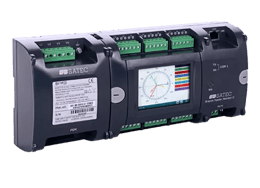
The service and the feeders. One revenue-class meter at each service or feeder the code names. A SATEC PRO Series meter on a feeder records kW demand the way the tariff bills it and kWh over whatever period the schedule asks for, at Class 0.2S per IEC 62053-22 and ANSI C12.20.
The categories. The end-use categories almost never line up with one breaker each. Lighting is spread across a floor, HVAC is a dozen circuits in three panels, plug loads are everywhere. A branch feeder monitor answers that without a wall of meters: one SATEC BFM-II meters up to 54 single-phase or 18 three-phase circuits from a single DIN rail unit, and its six virtual channels total the physical circuits into one reading per category, so a mixed panel reports HVAC, lighting and receptacles separately. It talks Modbus or BACnet to the building system, which is the world the panel shop already builds in.
The record. The 15-minute interval and the 36 months belong to the software layer above the meters, not to the meter alone. PAS power analysis software ships with every SATEC instrument at no charge for configuration and reporting; ExpertPower is the server layer that keeps the history, reports by category and shows the tenant and the operations staff what the code says they should be able to see. Write that layer into the specification, because an inspector reading ASHRAE 90.1 or the IECC will ask where the three years of data live.
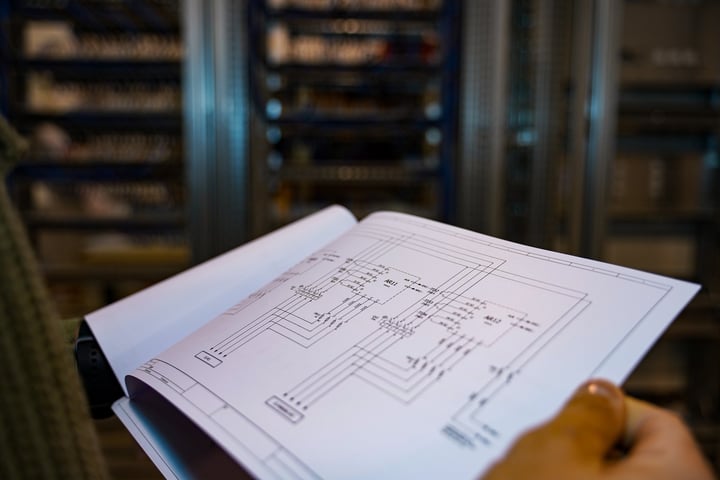
The meter count is set on the one-line, not by the code.
What to write on the schedule
Accuracy is a system property. A Class 0.2S meter reading through a 1 percent current transformer is a 1 percent system, and the code's sensor clause is written about the sensor for that reason. The schedule should carry three things so the panel shop can build it and the commissioning agent can verify it:
- The meter class, with its standard. Class 0.2S per IEC 62053-22 and ANSI C12.20 on the PRO Series and PM17x PRO; Class 0.5S on the BFM-II and the 13x line.
- The sensor and its own accuracy. SATEC HACS current sensors feed the meter directly, one CT in the chain instead of two. The datasheet gives 0.1 percent for solid core and 0.5 percent for split core. On the BFM-II the Class 0.5S rating holds with solid-core sensors; with split-core sensors the system reads Class 1, and the schedule should say which one is on the drawing.
- The data path. The protocol (Modbus TCP, or BACnet on the BFM-II), the system the readings land in, and who owns it after turnover.
Split-core sensors clip around a conductor on a site that keeps running, which is usually how metering goes into an existing building without a shutdown. On a new build, solid core is the easy choice because the conductor has not been pulled yet.
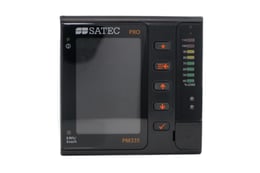 One more thing the code does not ask for and the owner will: the same PRO Series meter that satisfies the kW and kWh line is a Class A Edition 3.1 power quality analyzer, so the sag that tripped the chiller at shift change has a time and a depth on file. That is the reason a lot of our customers put the PRO meter on the feeder even where a plain energy meter would pass.
Questions to settle before the drawings go out
- Which code and which edition is the permit under, and has the building department amended the metering section?
- Is the building above the threshold, and if not, does the owner still want the categories separated while the conductors are being pulled anyway?
- Which panels carry which categories, and does any category sit in more than one panel?
- Does the building have a digital control system the data has to reach, and who owns it after turnover?
- Where will the 36 months of history live, and who will look at it?
We size the metering schedule against the section that applies, and we have done it for campuses, plants and multi-building sites on all three codes. The energy systems page shows where metering sits among the rest of the lines we carry for that work, and the Power That Performs chapter of the Design Path is where the standards questions on the power side live.
At Dynamic we represent power, control and measurement lines for consulting engineers, panel shops and machine builders in Northern California and Northern Nevada, and we are the SATEC rep across the territory. We help at the one-line and panel schedule stage, where a meter is cheapest to add and the categories are easiest to separate.
Working a job with an energy metering requirement right now? Send us the one-line or the panel schedule and we will come back with the meter count and a schedule you can put on the drawing.