
Opens mobile navigation.
Why Product Testing is important
- Comparison with the competition (in terms of Technology used & Production Process).
- Compare the improvements in SSR manufacturing and process changes that Celduc has implemented versus the competition (continuous improvement in products).
- Ensure and maintain product quality: By implementing ongoing testing of products selected at random from our inventory, we ensure that product performance is consistent with our specifications and that our manufacturing processes are meeting our standards. If any deviations are detected, corrective actions are taken.
The goal of these product lifetime tests was to measure the number of cycles the products could withstand.
|
Note: The number of cycles mentioned here is not to be used as qualification data. The results presented are a comparison between different brands of SSRs. |
Testing Conditions
Extensive life cycle testing was needed to stress the tested parts. Products designed for years of use, such as Solid State Relays, would take years of standard testing to determine life cycle limitations. Thus, accelerated life testing is used to evaluate a product’s lifecycle while speeding up the aging process.
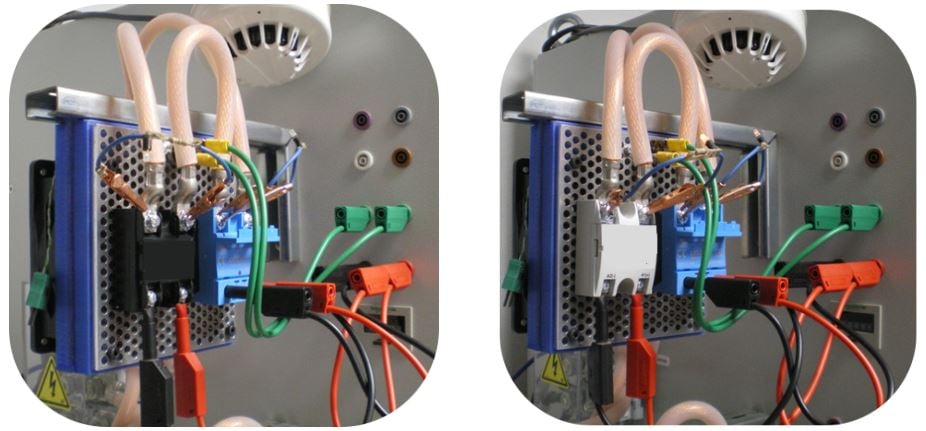
During our evaluation, we subjected equivalent SSRs from Celduc and two of our major competitors to the same test conditions. The tests were performed in our laboratory.
During the accelerated life testing, rapid heating and cooling of the relays was done. The test was set with the Rthjc (junction-to-case thermal resistance) of Celduc’s 50A single-phase SSR part number SO965460.
The parameters which were used are listed below. The same tightening torque of 1.9 Nm was used for mounting all three brands of SSRs.
| Test current (A) | Ptotal (W) | Rth (K/W) | ΔTjc calc (°C) | TjMa x (°C) | T Max possible (°C) | T Min (°C) | T Max Selected (°C) | ΔTjc cycled (°C) | Ton (sec) | Toff (sec) |
| 50 | 64 | 0.7 | 38 | 125 | 87 | 40 | 85 | 87 | 90 | 90 |
In this report, we are not mentioning the competitor SSR brand names. They will be named as « Competitor 1 » and « Competitor 2 ».
Overview of the results
After several months of running tests, here are the results:
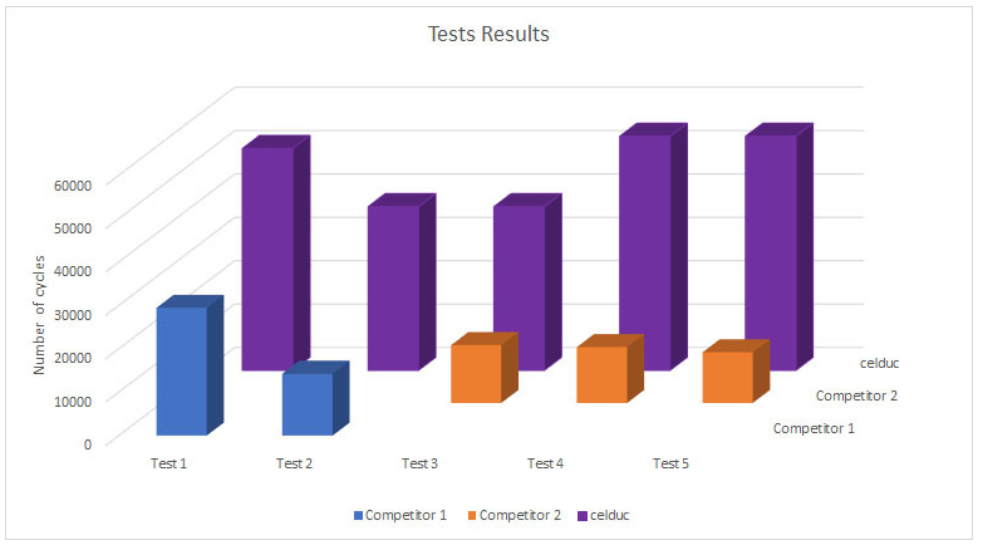
As shown above, the Celduc SSRs had a lifetime of more than twice the competitors that we tested under the same conditions.
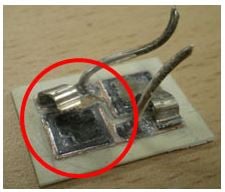
Competitor 1 – Cause of failure: Delamination of the Copper Bridge
For Competitor 1, the same cause of failure was observed for both SSRs which were tested: delamination of the solder between the copper bridge and the dice leading to temperature increase of the connection and destruction of the thyristor chip.
Result of defect for Competitor 1: Short-circuit
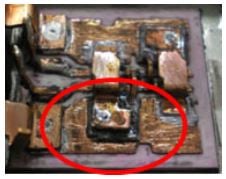
Competitor 2 – Cause of failure: melting of the power chip
For Competitor 2, the same cause of failure was observed: melting of the power chip
Result of defect for Competitor 2: Short-circuit (Output)
Result of defect for Competitor 2: Short-circuit (Output)
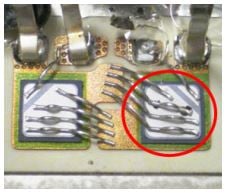
For the Celduc SSRs – cause of failure: BOnding Wire Lift-Up = Open-circuit (Output)
The typical failure for the Celduc SSRs was a lift-up, meaning the bonding wire is no longer connected to the power chip. This is due to its small size and flexibility. With this type of failure, you have less fire risk as it results in an open circuit.
Result of defect for Celduc: Open-circuit (Output)
Result of defect for Celduc: Open-circuit (Output)