Why legacy hardware decisions quietly limit modern machine design
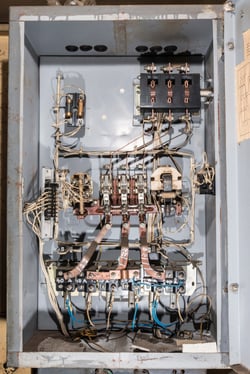
Most machines do not fail because of a single bad component. They fall behind because of a series of reasonable decisions that made sense at the time but quietly constrain what the system can become.
This is innovation debt.
Innovation debt accumulates when power architectures, control strategies, or data pathways are designed only to meet today’s requirements, with little consideration for how the system will scale, integrate, or adapt over its service life. The machine may run reliably, but it becomes increasingly difficult to add diagnostics, new sensors, performance improvements, or modern networking without costly redesign.
If you have ever thought, “The machine works fine, but we cannot easily add that feature,” you have already encountered innovation debt.
What Innovation Debt Looks Like in Practice
Innovation debt rarely appears as an obvious failure. Instead, it shows up as friction during design changes, upgrades, or expansions.
Common signs include:
-
Power supplies sized for nominal loads with no margin for new devices or higher efficiency architectures
-
Control systems that rely on hardwired IO and fixed logic, making changes slow and expensive
-
Networks built with unmanaged switches or proprietary protocols that limit diagnostics and visibility
-
Increasing downtime caused by issues that are difficult to trace or quantify
Individually, these choices seem minor. Collectively, they lock the system into yesterday’s assumptions.
Power Systems: When “Good Enough” Becomes a Constraint
Power is often the first place innovation debt takes root. Traditional silicon based power supplies may meet voltage and current requirements, but they often impose limits on efficiency, thermal performance, and physical footprint.
Modern machines increasingly demand:
-
Higher power density
-
Lower heat generation inside dense control cabinets
-
Stable output under dynamic and transient loads
-
Support for distributed and edge devices
Wide bandgap technologies such as GaN and SiC enable smaller, more efficient power supplies with reduced thermal stress. This is not just about efficiency percentages. It directly affects enclosure size, cooling requirements, and long term reliability.
Designing power systems with no allowance for future load growth or distributed architectures often forces a full redesign later, rather than a controlled upgrade.
Innovation debt in power is expensive because it is foundational. Everything downstream depends on it.
Control Architecture: The Cost of Rigid Systems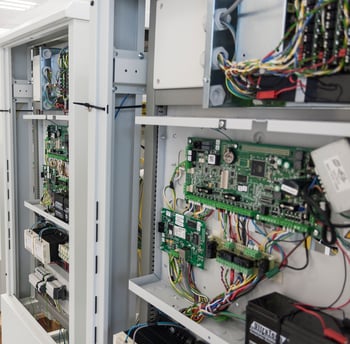
Control systems are often designed around known sequences and fixed IO counts. That works until the process evolves.
Legacy control architectures commonly suffer from:
-
Limited device level diagnostics
-
Rigid wiring schemes that are difficult to modify
-
High effort required to add sensors or feedback points
-
Poor separation between machine control and data collection
Modern control strategies increasingly rely on distributed IO, intelligent devices, and standardized communication. IO-Link, remote IO, and modular control architectures allow engineers to add capability without tearing apart the system.
Innovation debt in control does not usually stop the machine from running. It stops the machine from improving.
Data Pathways: The Invisible Bottleneck
Data is often treated as an afterthought in machine design. Unmanaged switches and basic Ethernet connectivity appear sufficient during early builds. Problems emerge once systems scale.
Common data related symptoms of innovation debt include:
-
No visibility into network health or traffic
-
Difficulty diagnosing intermittent faults
-
Limited ability to extract useful operational data
-
Bottlenecks when additional devices are added
Managed industrial Ethernet switches, deterministic networking, and edge capable devices provide more than connectivity. They enable diagnostics, segmentation, and future integration with higher level systems.
Without these capabilities, engineers are forced to troubleshoot blind. Downtime increases, and root cause analysis becomes guesswork.
Data debt compounds quickly because every added device increases complexity without increasing visibility.
Why Innovation Debt Is Hard to See Early
Innovation debt is rarely obvious during initial commissioning. The system meets requirements, passes acceptance testing, and ships.
The cost appears later:
-
When a customer asks for new functionality
-
When downtime increases but root cause is unclear
-
When adding one sensor requires days of rework
-
When supply chain disruptions force component changes
At that point, the machine is already deployed, and options are limited.
Designing for Progress, Not Just Compliance
Reducing innovation debt does not require overengineering or wholesale redesigns. It requires intentional choices in a few critical areas:
-
Power systems with efficiency, thermal headroom, and scalability
-
Control architectures that support modular expansion
-
Data pathways that provide visibility, diagnostics, and flexibility
These decisions protect future options. They allow machines to evolve alongside customer needs, regulatory changes, and new technologies.
Where Dynamic Fits In
At Dynamic Measurement and Control Solutions, our role is not to replace what already works. It is to help engineers identify where today’s design choices may limit tomorrow’s performance.
We work with machine builders early in the design process to evaluate power, control, and data architectures with an eye toward long term flexibility, reliability, and supportability.
If you are designing a system that needs to last, scale, or adapt, innovation debt is worth addressing now, while the cost of change is still low.
If you would like a second set of eyes on your architecture or want to discuss practical ways to modernize without overcomplicating your design, we are always available to support that conversation.