To get 24 V control power from a high-voltage DC bus, use a DC/DC converter rated for the full swing of that bus. To run an AC motor load from the same bus, use a DC/AC inverter rated for the same input range. Both exist as standard industrial hardware today for buses in the 400 to 1,100 VDC range.
The harder part is the specification. A battery or a DC bus does not sit at one voltage, and the converter has to work at both ends of the swing.
Why the high-voltage bus changes the power design
Machines used to take AC from the wall. More of them now carry or sit on a DC bus: a traction battery on a vehicle, a storage pack, or an 800 VDC distribution bus in a data center.
The controllers, sensors and network gear inside the machine still need 24 V. The pumps, fans and compressors still need AC. Both now have to come from the bus.
That leaves the designer two questions. How do I get low-voltage control power from the bus? And how do I run the AC loads without a separate AC feed?
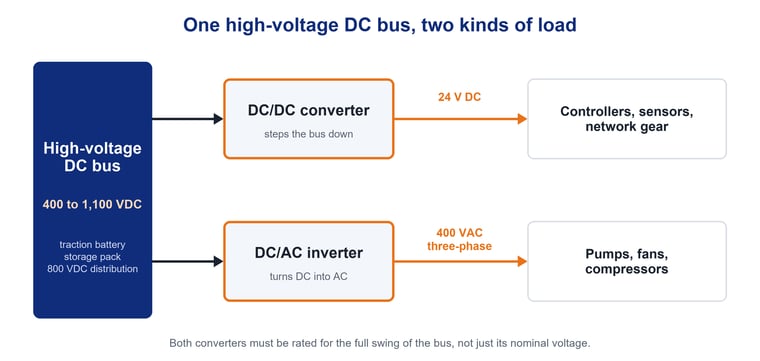
One bus feeds both: a DC/DC converter for the controls and a DC/AC inverter for the motor loads.
Start with the real input range
A nominal bus voltage is only the middle of the range. A battery swings from full charge to end of discharge. A catenary sags and surges. A bus sees transients when large loads switch.
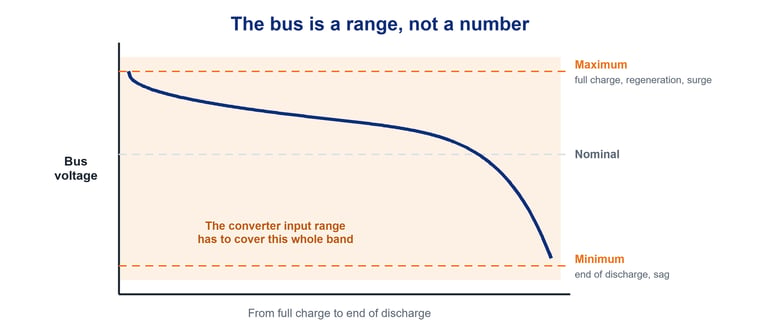
A battery bus moves between a maximum and a minimum. The converter has to run across all of it.
Write down four numbers before you look at a part.
- Minimum bus voltage. The lowest voltage at which the load must still run.
- Maximum bus voltage. Full charge, regeneration or surge.
- Continuous load. What the load draws all day.
- Peak load and its duration. Motor starts and other short peaks.
A converter that covers the nominal voltage but not the minimum will drop the controls exactly when the battery is low.
24 V control power straight from the bus
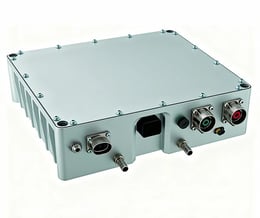 A wide-input DC/DC converter takes the bus voltage and delivers 24 V for controllers, sensors and network gear. Two Premium PSU examples show the range of what is standard.
- CVS-280. Takes 400 to 1,100 VDC.
- CMS-2000. A 2 kW unit that takes 180 to 950 VDC and is sealed to IP67 and IP69K, for a vehicle or an outdoor machine.
For lower battery voltages, one CLS part number takes 16.8 to 137.5 VDC on a single input. That covers 24, 36, 48, 72 and 110 V batteries with one part.
AC loads from the same bus
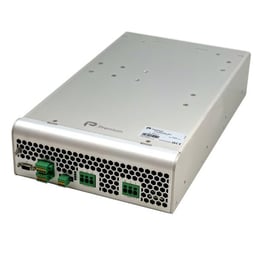 Pumps, fans and compressors are often the largest loads left on AC. A DC/AC inverter runs them from the bus, so the machine needs no AC distribution of its own.
- NP-0827. Runs from 420 to 900 VDC and delivers 400 VAC three-phase.
- OVX-6400. Makes 6.4 kVA three-phase from 400 to 1,000 VDC, and up to four units run in parallel.
- TDS and TDX-3300. Make 3.3 kW at 5 to 75 Hz from 400 to 740 VDC, so a compressor can run straight from a high-voltage battery.
Sizing for the peak
A motor draws several times its running current when it starts. An inverter or converter sized only for the running load will fold back or trip on the start.
Ask for the peak rating and how long the unit holds it. On one wind turbine application, a DC/DC converter with real overload capability keeps the lubrication pumps running through a grid outage. It rides the motor inrush instead of letting the voltage collapse.
Where the load can be measured, measure it. On an automated vehicle carrying a robot arm, Premium's engineers put a scope on the real load profile on site and sized the inverter for the peak currents of the arm's fastest moves.
Heat and the environment
A supply in a sealed box has no airflow, and most supplies lose output as the temperature rises. Check the temperature at which the unit still delivers its nameplate power.
The CLS family holds nameplate power to +70 C. In a sealed enclosure that can be the difference between the 300 W unit and the 500 W one.
Premium's rail families are engineered to meet EN 50155, EN 45545-2 and EN 61373. Those are the railway standards for electronics, fire and smoke, and shock and vibration. A machine that moves lives in much the same conditions.
Catalog, modified standard or custom
When a catalog unit fits, use it. When it nearly fits, a modified standard unit changes one thing: an input range, an output voltage, a connector or a frequency. When nothing fits, a custom design starts from the specification.
Premium has more than 900 custom designs behind it, and about 50 of its 130 people work in R&D. All three paths are normal work there. A custom design makes economic sense at production volume and rarely for a single prototype.
What drives the cost
- Power level. Continuous and peak.
- Input range. A wider or higher input range costs more than a narrow one.
- Sealing and environment. A sealed, vibration-rated unit costs more than an open-frame one.
- Redundancy. Parallel units and transfer switches add hardware.
- Catalog or custom. A custom design carries engineering cost that only pays back across a production run.
How it is bought and who supports it here
Dynamic is the Premium PSU rep for Northern California and Northern Nevada. Bring us the four numbers above and the environment. We will work the selection with you and with Premium's engineers, and tell you whether it is a catalog part, a modified standard or a custom design.
The Premium PSU page has the full range, with sections for rail and vehicles and for the 800 VDC data center bus
At Dynamic we represent power, control and measurement lines for machine builders, panel shops and plants in Northern California and Northern Nevada, and we are Premium PSU's rep across the territory.