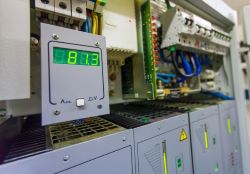
To measure current on a high-voltage DC bus, put a shunt in the bus and read it with a transducer that sits at bus potential and isolates the signal. To measure the bus voltage, use a voltage transducer rated for the bus itself. Both hand the controller a standard 4 to 20 mA or 10 V signal that is safe to wire into a panel.
The isolation is the whole job. The measurement is small. The voltage it rides on is not.
Why DC is harder to measure than AC
On an AC system, current transformers and voltage transformers do the isolating. They are simple, proven and everywhere.
Neither works on DC. A DC bus has no zero crossing, and a transformer cannot pass a steady current. So ripple, unbalance and ground faults on a DC bus go unmeasured unless something is built to read them at high potential.
That matters more each year. Battery storage, traction power and the 800 VDC bus in new data centers all put kilovolt DC where a controller needs a reading.
Current: a shunt and a transducer at bus potential
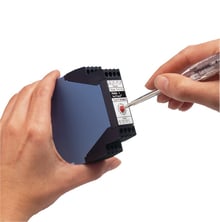 A shunt is a precise, low-value resistor placed in the bus. Current through it produces a small voltage, often tens of millivolts. That small voltage is the measurement.
The difficulty is where it sits. The shunt is on the bus, so its millivolt signal rides on top of the full bus voltage. The transducer mounts beside the shunt at bus potential, reads the millivolts, and passes an isolated signal across to the controller.
Knick's P41000 does this job. It takes shunt inputs from 50 mV to 100 V, with a gain error under 0.1 percent and a working voltage of 3,600 V. Knick's shunts run from 1 A to 20 kA.
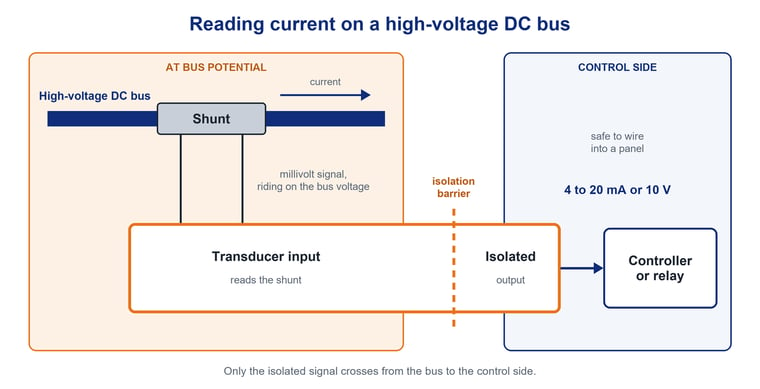
The shunt and the transducer input sit at bus potential. Only the isolated signal crosses to the control side.
Voltage: a transducer rated for the bus itself
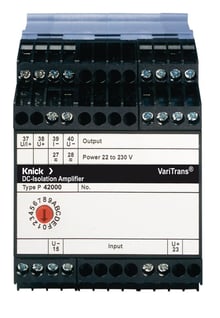 Bus voltage is measured directly at high potential. The isolation is rated for the bus itself, so there is no divider in front of a low-voltage input.
Knick's P42000 takes inputs from 100 V to 3,600 V across 16 calibrated, switchable ranges, with a gain error under 0.3 percent. For systems built to a safety integrity level, the P45000 takes inputs to 3,000 V with reinforced insulation to 4,800 V, and is built for SIL 2 systems.
Four numbers that decide the part
- Working voltage. The continuous voltage across the isolation. It must cover the bus at its highest, with margin for the system's insulation rules.
- Test voltage. What the isolation is proven to withstand. Knick type tests its high-voltage families at 10 or 15 kV AC.
- Speed. A protection or control loop needs the reading while the event is happening. Knick's shunt and voltage transducers have a rise time of about 110 microseconds.
- Common-mode rejection. How well the transducer ignores the kilovolts the shunt sits on. Knick's shunt transducer rejects common mode by more than 150 dB.
Temperature at bus potential
A hot joint on a busbar is a fault that has not happened yet. A Pt100 sensor clamped to the joint reads the hot spot, with the sensor at bus potential and the output isolated from it. Knick's P44000 takes a Pt100 input with isolation to 2,000 V or 6,600 V.
Where these measurements are used
- Battery storage and battery test. A pack test bench or a battery cycler needs bipolar current measured over years of cycles.
- Traction power. Knick's transducers are rated for DC railway systems to 3,000 V DC.
- The 800 VDC data center bus. A shunt and a bus-voltage transducer give the owner power, energy and direction from a measurement that is separate from the converter's own.
- Electrolyzers and fuel cells. Stack voltage is read at stack potential.
What drives the cost
- Isolation voltage. A higher working voltage is a larger, more expensive transducer.
- Shunt current rating and accuracy class. A 20 kA shunt costs more than a 100 A one, and a tighter class costs more.
- Safety integrity level. A transducer built for SIL 2 or SIL 3 systems costs more than a standard one.
- How many measuring points. Current, voltage and temperature at each point add up.
How it is bought and who supports it here
Knick transducers are made in Berlin and supported from Knick Interface in California. At Dynamic we represent Knick Interface in Northern California and Northern Nevada. Send us the measuring point: the position on the bus, the voltage and current rating, and what the signal reports to. We will work the selection with you and with Knick.
The Knick Interface page has the full range. For power from the same bus, see how to get 24 V control power and AC from a high-voltage DC bus
At Dynamic we represent power, control and measurement lines for machine builders, panel shops and plants in Northern California and Northern Nevada, and we represent Knick Interface across the territory.